Menopause, HRT and Hair: What's the Real Connection?
07 August, 2026 | Jabbar Ali - MPharm
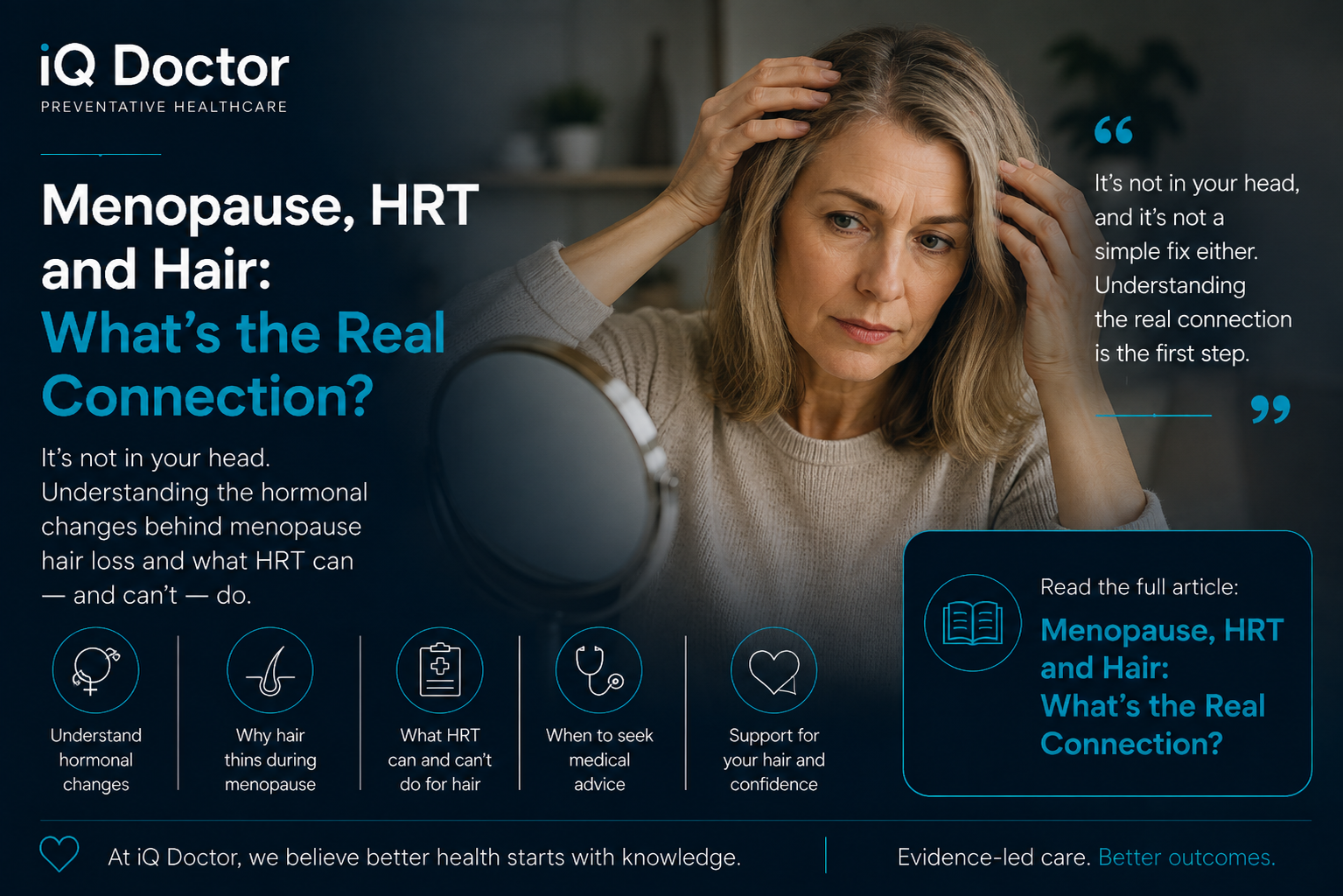
If you're noticing more hair in the shower drain around the same time as hot flushes, disrupted sleep or brain fog, you're not imagining a connection. Hair is genuinely sensitive to the hormonal shifts of perimenopause and menopause, and it's one of the least talked-about symptoms of a transition that's already crowded with more urgent-feeling ones.
What's less straightforward is what to do about it, particularly when it comes to HRT. It's easy to find confident claims in both directions online: that HRT will restore your hair, or that it makes no difference at all. The honest picture sits between the two, and understanding it properly is more useful than either promise.
What this article covers
- Why the hair follicle is genuinely sensitive to hormonal change at menopause
- The difference between temporary shedding and progressive thinning, and why it matters
- What the evidence actually shows about HRT and hair, and where it falls short of a guarantee
- Why the type of HRT matters, and how testosterone-containing regimens differ
- Where this fits alongside the rest of the hair loss cluster and your wider menopause care
Why your hair notices the menopause transition
The hair follicle is an oestrogen-sensitive tissue, which is a slightly clinical way of saying it responds directly to the hormonal shifts most associated with menopause.(1)
Oestrogen helps keep hair in its active growth phase for longer; as levels fall, sometimes years before periods stop altogether, more hairs than usual can shift into the resting and shedding phases at once.(2)
At the same time, while oestrogen is falling, the level of androgens, hormones present in everyone regardless of sex, tends to stay roughly the same or become relatively more dominant by comparison.
That shifting ratio, rather than androgens necessarily rising in absolute terms, is thought to be a key driver of the pattern thinning some women notice at the crown and parting during and after the menopause transition.(1,3)
Temporary shedding or progressive thinning? The distinction that matters
Not all menopause-related hair change is the same, and the distinction is more useful than it sounds.
Telogen effluvium is a temporary, diffuse shedding, more hair than usual coming out all over, often triggered by a hormonal shift, stress, illness or significant weight change, that typically settles on its own within several months.(2,3)
Female pattern hair loss, by contrast, is a gradual, progressive thinning, usually most visible at the crown or parting, that doesn't reverse on its own and is linked more specifically to the changing oestrogen-to-androgen balance described above.(1)
A cross-sectional study of postmenopausal women found female pattern hair loss to be a common finding at this life stage, alongside telogen effluvium.(4)
A less common but distinct pattern, frontal fibrosing alopecia, causing hairline recession, has also been noted with higher frequency in postmenopausal women and is worth a GP or dermatologist review if you notice it, since it's managed differently.(3,5)
If you're not sure which you're dealing with, that's a reasonable thing to ask a GP or prescriber to help distinguish, rather than something to work out alone.
What the evidence actually shows about HRT and hair
This is where it's worth being precise rather than reassuring. HRT is not a licensed treatment for hair loss, and it isn't generally prescribed for that reason alone.
What the evidence does support is more modest: because oestrogen helps support the hair growth phase, restoring it through HRT may help slow ongoing shedding for some women, particularly when started reasonably close to the onset of menopausal symptoms, though robust, hair-specific clinical trial data remains limited compared to HRT's evidence base for hot flushes, bone health or mood.(2,5)
In practice, this means HRT is best understood as something that may offer a secondary benefit to hair, alongside its primary role in managing menopausal symptoms, rather than a treatment to start on the strength of hair loss alone.
Some women taking HRT for other symptoms do notice their shedding settle; others notice little change in their hair specifically, and that variation is genuinely expected rather than a sign the treatment “isn't working”.
Why the type of HRT matters
Not all HRT is equal when it comes to hair, and this is a genuinely useful thing to understand before starting or adjusting treatment.
Oestrogen, with or without progesterone, is the combination most associated with a potential benefit for hair.(2,5)
Testosterone is sometimes added to HRT regimens, usually to help with low libido rather than hair, and this is where it gets more complicated: testosterone can be converted in the body to DHT, the same hormone implicated in pattern hair loss, meaning testosterone-containing HRT can, for some women, work against the hair benefit that oestrogen provides elsewhere in the same regimen.(5)
None of this means testosterone shouldn't be prescribed where it's genuinely needed for other symptoms; it means hair is worth flagging explicitly as a factor when a prescriber is reviewing your HRT formulation and dose, particularly if thinning is something you're already noticing or concerned about.
“Patients often come to us hoping HRT will be the single answer to their hair loss, and I understand why, it's an appealing idea. The honest answer is that it can genuinely help some women as part of a wider picture, but it isn't a guarantee, and it isn't a reason on its own to start hormone therapy. I'd rather talk someone through what's realistic than let them start treatment on a promise we can't back up.”
Omar El-Gohary, Superintendent Pharmacist, iQ Doctor
Where this fits alongside the rest of your menopause and hair loss picture
This article has focused specifically on the hormonal connection between menopause, HRT and hair, rather than repeating the general causes, treatments or day-to-day coping strategies covered elsewhere in this series.
If you haven't yet explored those, our articles on the causes of female hair loss, treatment options, and coping with hair loss day to day cover that ground in full, and our piece on the wider symptoms of low oestrogen is a useful companion if hair loss is one of several changes you're noticing at once.
Want clarity on what's driving your symptoms?
A simple hormone test can help build a clearer picture of where you are in the menopause transition, and whether HRT is worth discussing with a prescriber, for your hair or your wider symptoms.
Explore the menopause hormone test at iQ Doctor
Frequently asked questions
The following questions are answered with reference to current understanding of the hormonal connection between menopause, HRT and hair. If you have specific concerns about your health, please speak to a qualified healthcare professional.
Is hair loss a real symptom of menopause, or is it a coincidence?
It's a real, hormonally-driven symptom for many women, not a coincidence. Declining oestrogen and a relative shift in the oestrogen-to-androgen balance both affect the hair follicle directly, contributing to shedding and thinning during and after the menopause transition.
Will HRT stop or reverse my hair loss?
It might help, but it's not guaranteed and isn't a licensed hair loss treatment. Some women taking HRT, particularly oestrogen-based regimens, notice their shedding settle; others notice little change specifically in their hair. It's reasonable to raise hair as one factor when reviewing HRT, but not a reason to start it alone.
Why would HRT make hair loss worse for some women?
This is usually related to testosterone-containing HRT, sometimes prescribed for low libido. Testosterone can convert to DHT in the body, the same hormone linked to pattern hair loss, which can work against any hair benefit from the oestrogen in the same regimen.
How do I know if it's just shedding or something more permanent?
Diffuse shedding that comes on relatively suddenly, known as telogen effluvium, tends to settle within several months and is often linked to a hormonal shift, stress or illness. Gradual thinning at the crown or parting that doesn't reverse is more likely female pattern hair loss. A GP or prescriber can help distinguish the two if you're not sure.
Should I start HRT specifically because of hair loss?
Current evidence doesn't support starting HRT for hair loss alone. It's better understood as a possible secondary benefit for some women already taking it, or considering it, for other menopausal symptoms, rather than a stand-alone hair treatment.
What should I ask my GP or prescriber about HRT and hair?
It's reasonable to ask whether your specific hair pattern looks like shedding or progressive thinning, whether your current or proposed HRT formulation includes testosterone, and whether a hormone test would help build a clearer picture before making changes.
References
-
Mirmirani P. Hormonal changes in menopause: do they contribute to a 'midlife hair crisis' in women? Br J Dermatol. 2011;165(Suppl 3):7–11. Available from:
https://doi.org/10.1111/j.1365-2133.2011.10629.x
-
Rinaldi F, Trink A, Mondadori G, Giuliani G, Pinto D. The menopausal transition: is the hair follicle 'going through menopause'? Biomedicines. 2023;11(11):3041. Available from:
https://doi.org/10.3390/biomedicines11113041
-
Kamp E, Ashraf M, Musbahi E, DeGiovanni C. Menopause, skin and common dermatoses. Part 1: hair disorders. Clin Exp Dermatol. 2022;47(11):2110–2116. Available from:
https://doi.org/10.1111/ced.15327
-
Chaikittisilpa S, Rattanasirisin N, Panchaprateep R, Orprayoon N, Phutrakul P, Suwan A, Jaisamrarn U. Prevalence of female pattern hair loss in postmenopausal women: a cross-sectional study. Menopause. 2022;29(4):415–420. Available from:
https://doi.org/10.1097/gme.0000000000001927
-
Gupta AK, Economopoulos V, Mann A, Wang T, Mirmirani P. Menopause and hair loss in women: exploring the hormonal transition. Maturitas. 2025;198:108378. Available from:
https://doi.org/10.1016/j.maturitas.2025.108378
Our Clinical Authors
This page has been written by a registered UK pharmacist and reviewed by our clinical team to ensure it is accurate, clear and reflects current clinical guidance.
Last medically reviewed: 07 August, 2026
Last updated: 07 August, 2026