Why Am I Losing My Hair? Common Causes of Female Hair Loss
19 July, 2026 | Jabbar Ali - MPharm
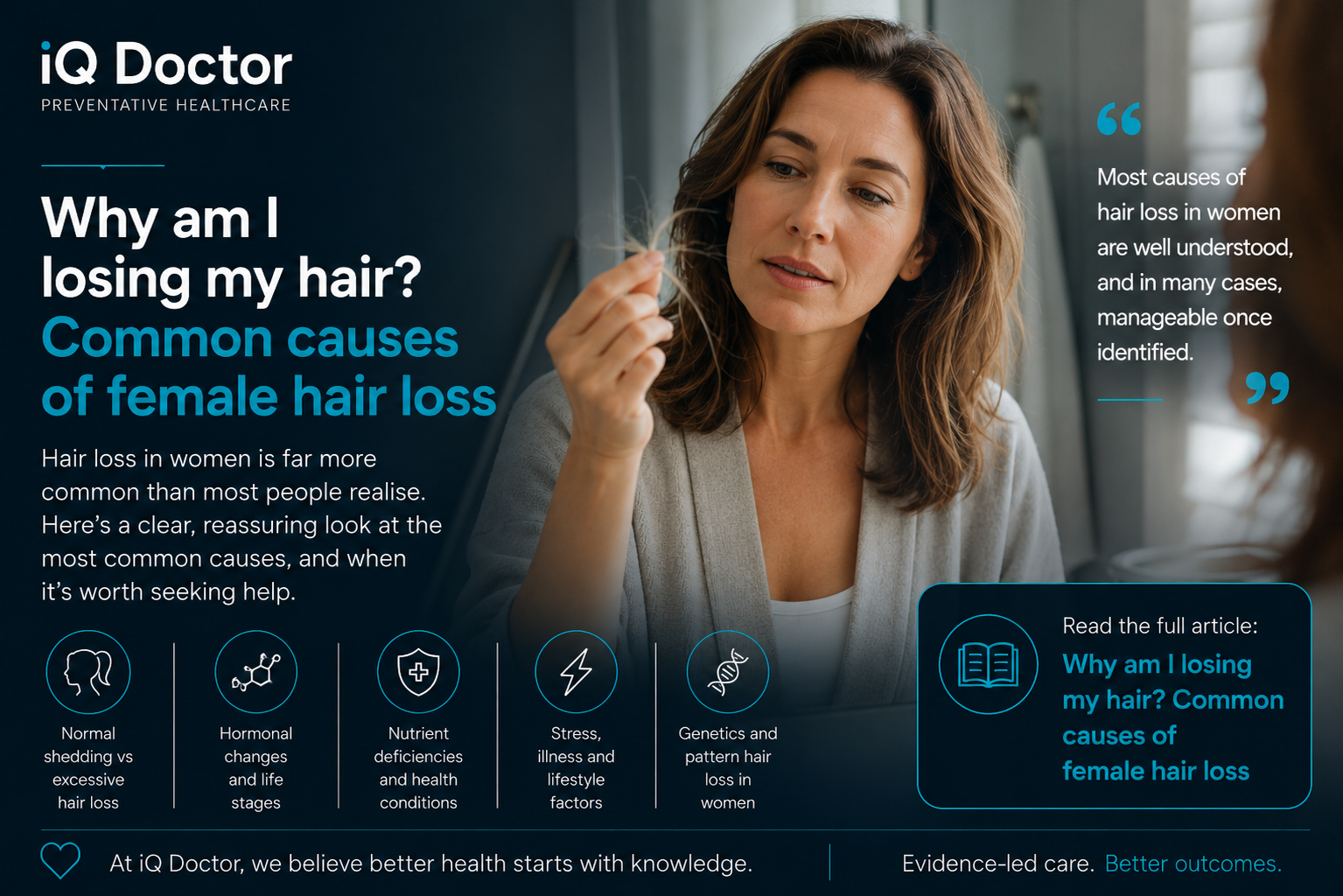
It starts as a small thing. A few more strands on the pillow than you remember. A little more in the plughole after a shower. Then, one morning, more in the brush than seems reasonable, and a question that's hard to shake once it arrives: why am I losing my hair?
If you've typed some version of that question into a search bar recently, you're in good company. Hair loss in women is far more common than most people realise; by some estimates, as many as half of all women will notice some form of hair thinning during their lifetime.(1) And yet it rarely gets talked about openly, which can make an already unsettling experience feel isolating too.
The reassuring part is that most causes of hair loss in women are well understood, well studied, and in many cases, manageable once identified. In this article I want to walk through the most common reasons women notice hair loss, what distinguishes one cause from another, and when it's worth having it properly looked at.
What this article covers
- How much hair loss is actually normal
- The most common causes of hair loss in women
- How to tell one cause from another
- When hair loss is worth a closer look
- What happens once you seek advice
You're not imagining it; hair loss in women is common
One of the quiet difficulties of noticing hair loss is wondering whether you're overreacting. Hair loss is so often pictured as a male experience that many women feel there's no established script for what they're going through, or worse, that it must mean something is seriously wrong.
Neither is usually true. Hair loss in women has several distinct, well-documented causes, ranging from genetics to hormones to nutrition to stress. None of them are your fault, and almost all of them are worth investigating rather than quietly living with.
How much hair loss is normal
Hair grows in overlapping cycles. At any given time, roughly ninety percent of the hair on your scalp is actively growing, while the remaining ten percent is resting before it sheds to make room for new growth. Losing somewhere between fifty and one hundred hairs a day sits comfortably within that normal cycle.
What's worth paying attention to is a clear change from your own baseline: shedding that is noticeably heavier than usual, a hairbrush that fills faster than it used to, visible thinning in photographs or in the mirror, a parting that seems to be widening, or a patch where hair has come away in one defined area. The pattern you're seeing is usually the first clue to what's causing it.
The most common causes of female hair loss
Below are the causes we see most often. Many women have more than one contributing factor at once, which is part of why an accurate diagnosis matters more than guessing from a list.
Female pattern hair loss
This is the most common cause of hair thinning in women, and it looks different from the pattern most people associate with men. Rather than a receding hairline, it usually shows up as gradual, diffuse thinning at the crown and along the centre parting, which can appear to widen slowly over time.(1) It's driven by a genetic sensitivity to androgens in certain hair follicles, tends to run in families, and often becomes more noticeable around and after menopause.
Telogen effluvium: shedding after a stressful period
Telogen effluvium is a temporary, diffuse shedding that happens when a stressor, physical or emotional, pushes an unusually large number of hair follicles into their resting phase at once.(2) Because hair takes roughly two to three months to move from resting to actually falling out, the shedding is often noticed well after the event that triggered it: an illness, a surgery, a period of intense stress, or a significant change in weight. In most cases it resolves within six to nine months once things settle.
Postpartum hormonal shifts
Pregnancy hormones extend the growth phase of hair, which is part of why hair often feels fuller during pregnancy. After childbirth, oestrogen levels fall sharply, and the hair that had its shedding delayed is released all at once. This usually starts two to four months after delivery and is a recognised, temporary form of telogen effluvium that typically resolves within six to twelve months.(2)
Thyroid imbalance
The thyroid gland has a direct influence on the hair growth cycle.(3) Both an underactive and an overactive thyroid can cause diffuse thinning, often alongside other symptoms such as fatigue, changes in weight, or sensitivity to temperature. A simple blood test can check thyroid function and rule this in or out.
Iron deficiency
Low iron stores are one of the most common, and most overlooked, causes of hair thinning in women, particularly those with heavy periods or a plant-based diet. Research shows that hair follicles are sensitive to falling iron levels even before those levels are low enough to cause conventional anaemia, which is why ferritin (a measure of stored iron) is usually tested specifically.(4)
Polycystic ovary syndrome (PCOS)
PCOS is associated with higher circulating levels of androgens, which in some women shows up as scalp hair thinning that resembles female pattern hair loss, sometimes alongside irregular periods, acne, or increased facial or body hair.(5) Because the hair changes overlap with other causes, PCOS-related hair loss is usually identified through the wider clinical picture rather than the hair alone.
Alopecia areata
Unlike the causes above, alopecia areata is an autoimmune condition in which the immune system mistakenly targets hair follicles, typically causing sudden, well-defined round or oval patches rather than diffuse thinning.(6) It can appear at any age, and its course varies considerably from person to person, which is why it usually benefits from a dedicated dermatological assessment.
Traction and styling-related hair loss
Prolonged tension from tightly pulled hairstyles; ponytails, braids, buns, or extensions worn consistently over long periods, can gradually damage the hair follicle, usually starting along the hairline. It's one of the few causes that can often be halted early simply by changing styling habits, though longstanding tension can eventually cause more lasting damage.
Not sure which of these fits what you're experiencing?
iQ Doctor's clinical team can help you make sense of your pattern of hair loss, and talk you through what, if anything, is worth investigating further.
Speak to the iQ Doctor team
"So many of the women I speak to have been quietly noticing this for months before they mention it. There's often a worry that it's either nothing, or something serious, when in reality there's usually a clear, identifiable cause somewhere in between; and once we find it, the conversation shifts from worry to a plan."
Omar El-Gohary, Superintendent Pharmacist, iQ Doctor
When hair loss is worth a closer look
Not every change needs an urgent appointment, but certain patterns are worth raising with a clinician sooner rather than later:
- Hair loss that is sudden or clearly faster than gradual thinning
- A defined patch with a clear edge, rather than diffuse thinning across the scalp
- Scalp symptoms such as itching, redness, or soreness
- Hair loss alongside fatigue, irregular periods, or unexplained weight change
- Hair loss that is affecting your confidence or wellbeing, regardless of how it would be clinically categorised
None of these on their own point to something serious. But they're all good reasons to have your pattern properly assessed, since the right next step depends entirely on identifying the right cause.
What happens once you seek advice
Getting an answer usually starts with a conversation: when the shedding began, whether it's diffuse or patchy, your family history, your cycle, and anything else going on health-wise. From there, a clinician may examine the scalp directly and, where useful, arrange blood tests to check thyroid function, iron levels, or hormones. Once the cause is clearer, treatment options; from topical minoxidil to addressing an underlying deficiency or condition, can be discussed properly. We cover this next stage in more detail in our companion article, Women's Hair Loss Explained: Causes, Treatments and When to Seek Help.
Ready to get some answers?
iQ Doctor offers confidential, clinician-reviewed consultations with UK-registered prescribers who can help you understand what's behind your hair loss and what can help.
Start a consultation at iQ Doctor
Frequently asked questions
The following questions are answered with reference to current clinical understanding. If you have specific concerns about your health, please speak to a qualified healthcare professional.
Why am I suddenly losing so much hair?
Sudden, noticeable shedding is most often telogen effluvium, a temporary reaction to a stressor such as illness, surgery, rapid weight loss, or a major emotional event, occurring roughly two to three months earlier. It usually settles on its own within six to nine months once the underlying trigger has passed.(2)
Is it normal to lose hair every day?
Yes. Losing somewhere between fifty and one hundred hairs a day is a normal part of the hair growth cycle. What's worth paying attention to is a clear change from your usual pattern: noticeably heavier shedding, visible thinning, a widening parting, or defined patches.
Can stress alone cause hair loss?
Yes. Significant physical or emotional stress can push more hair follicles than usual into the shedding phase of the growth cycle, a pattern known as telogen effluvium.(2,7) It typically appears a couple of months after the stressful period and resolves once things settle.
Could my hair loss be a sign of a health problem?
It can be. Thyroid dysfunction, iron deficiency and PCOS are all well-established, treatable causes of hair thinning in women.(3,4,5) A simple blood test can check for the most common of these, which is why it's worth mentioning hair changes to a clinician rather than assuming they're unrelated.
Why is my hair thinning at the crown and parting?
Gradual thinning at the crown and along the centre parting is the classic pattern of female pattern hair loss, a genetic condition involving increased sensitivity to androgens in certain hair follicles.(1) It tends to progress slowly and often becomes more noticeable around and after menopause.
Will my hair grow back?
It depends on the cause. Hair loss linked to stress, illness or childbirth is usually temporary and regrows once the trigger resolves. Female pattern hair loss tends to be progressive but can often be slowed or partially reversed with treatment. Alopecia areata is more unpredictable.(6) A proper diagnosis is the best way to understand what to expect.
When should I see a doctor about hair loss?
It's worth seeking a clinical review if hair loss is sudden or rapid, appears as a well-defined patch, comes with scalp itching or pain, or is accompanied by other symptoms such as fatigue, irregular periods or unexplained weight change. Gradual thinning is also worth discussing, both to identify the cause and to understand your options.
References
- Ramos PM, Miot HA. Female Pattern Hair Loss: a clinical and pathophysiological review. An Bras Dermatol. 2015;90(4):529;543. Available from: https://doi.org/10.1590/abd1806-4841.20153370
- Malkud S. Telogen Effluvium: A Review. J Clin Diagn Res. 2015;9(9):WE01;WE03. Available from: https://doi.org/10.7860/JCDR/2015/15219.6492
- van Beek N, Bodó E, Kromminga A, et al. Thyroid hormones directly alter human hair follicle functions. J Clin Endocrinol Metab. 2008;93(11):4381;4388. Available from: https://doi.org/10.1210/jc.2008-0283
- St Pierre SA, Vercellotti GM, Donovan JC, Hordinsky MK. Iron deficiency and diffuse nonscarring scalp alopecia in women: what is the evidence? J Am Acad Dermatol. 2010;63(6):1070;1076. Available from: https://doi.org/10.1016/j.jaad.2009.06.056
- Carmina E, Azziz R, Bergfeld W, et al. Female Pattern Hair Loss and Androgen Excess: A Report From the Multidisciplinary Androgen Excess and PCOS Committee. J Clin Endocrinol Metab. 2019;104(7):2875;2891. Available from: https://doi.org/10.1210/jc.2018-02548
- Pratt CH, King LE Jr, Messenger AG, Christiano AM, Sundberg JP. Alopecia areata. Nat Rev Dis Primers. 2017;3:17011. Available from: https://doi.org/10.1038/nrdp.2017.11
- Peters EM, Arck PC, Paus R. Hair growth inhibition by psychoemotional stress: a mouse model for neural mechanisms in hair growth control. Exp Dermatol. 2006;15(1):1;13. Available from: https://doi.org/10.1111/j.0906-6705.2005.00372.x
Our Clinical Authors
This page has been written by a registered UK pharmacist and reviewed by our clinical team to ensure it is accurate, clear and reflects current clinical guidance.
Last medically reviewed: 19 July, 2026
Last updated: 18 September, 2026