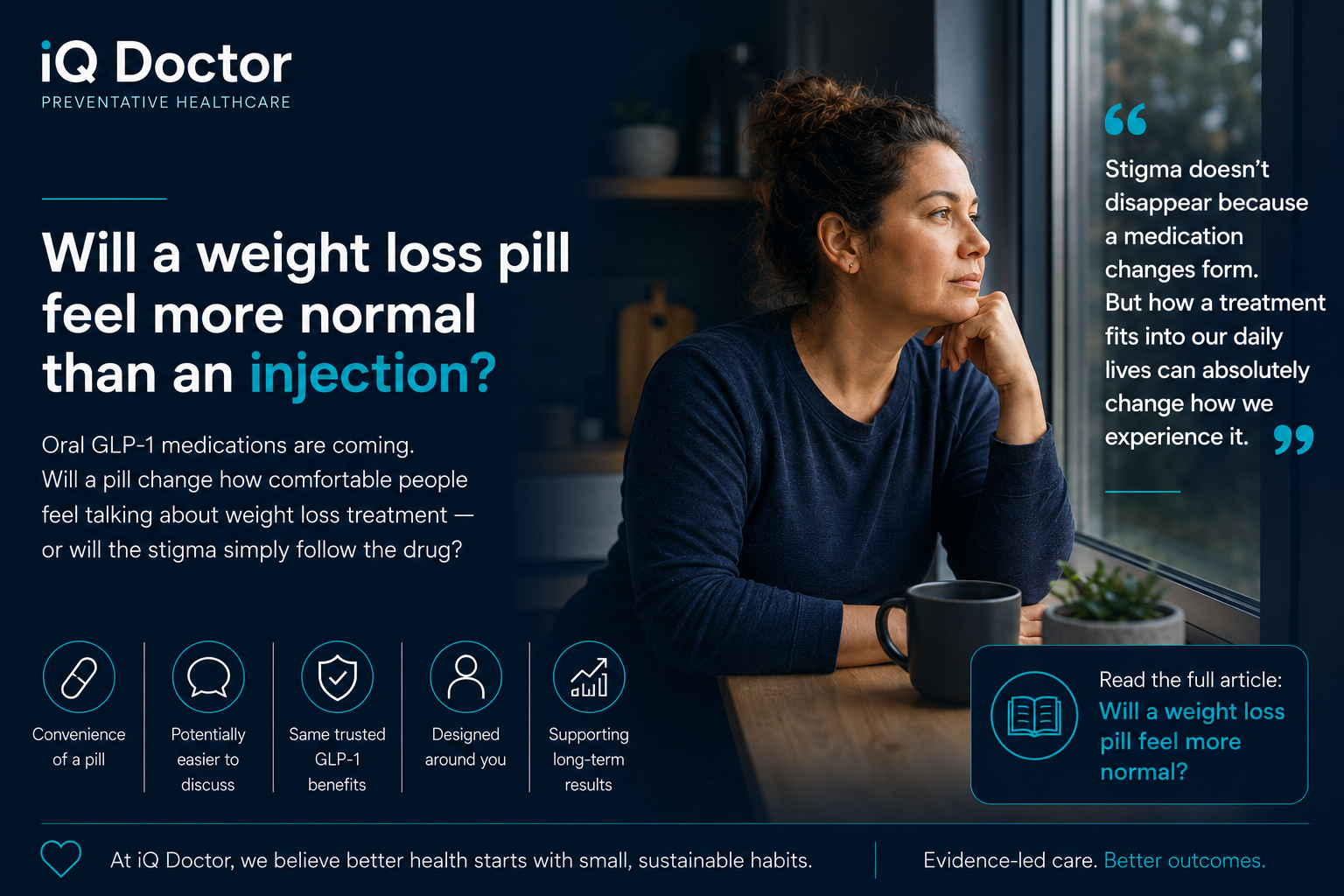
Will a weight loss pill feel more normal than an injection?
06 July, 2026 | Jabbar Ali - MPharm
They’ve been using it for months. The results are real. Their relationship with food has shifted in ways they couldn’t have predicted. And when someone at work notices and asks what’s changed, they deflect.
Because saying ‘I’m on an injection’ would require a conversation they don’t want to have.
That’s a scene that plays out many thousands of times a day across the UK right now. We have written before about why so many people keep their weight loss treatment private, and the evidence is clear: secrecy is widespread, the shame is real, and the clinical consequences are significant.
But the landscape is about to change. Oral formulations of GLP-1 receptor agonists are moving through development and regulatory pathways rapidly. Semaglutide as a daily tablet is already approved and available in some markets. Tirzepatide in oral form is in late-stage trials. The era of the weight loss pill is approaching.
And that raises a question almost nobody in the clinical space is asking yet: will a pill feel different?
Will people be more willing to talk about their treatment when it comes in a form they could mistake for a multivitamin? Does the way a drug is delivered change how socially acceptable it feels to take it? And if the stigma is real and persistent, will a change of format do anything meaningful to shift it?
These are not just philosophical questions. They have implications for adherence, for clinical transparency, for the kind of honest conversations patients need to have with their prescribers. They deserve serious exploration.
What this article covers
- Why the route of administration matters socially
- What we know about how pills are perceived differently from injections
- Whether the stigma is attached to the drug or the delivery
- The risk of a false normalisation effect
- What an oral GLP-1 pill would and would not change
- What this means for clinical conversations now
Why the route of administration matters, more than you might think
On a purely pharmacological level, how a drug enters your body should not change how society feels about you taking it. The mechanism of action of semaglutide is the same whether it arrives by subcutaneous injection or oral tablet. The clinical indication is the same. The patient is the same.
But socially, it is not the same at all.
We have extensive evidence from other medication classes that route of administration carries powerful and distinct social associations that bear no relationship to clinical logic. Injectable medications for conditions including rheumatoid arthritis, multiple sclerosis, and HIV have all been associated with additional stigma beyond what the underlying condition carries, simply because of the injection itself. Needles carry connotations: severity, medical dependence, a body that requires intervention of a different order than a pill.(1)
At the same time, tablets and capsules sit in a remarkably different cultural register. The medicine cabinet in most UK homes is full of them. Statins, antihypertensives, antidepressants, contraceptives, painkillers; the pill is so normalised as a format that its presence generates almost no social signal at all. You take it with breakfast and nobody asks.
This asymmetry is worth sitting with. The injection signals ‘serious medical intervention’ in a way that the pill does not. And in the context of weight management, where the social stakes around legitimacy are already extraordinarily high, that signal matters enormously.
What we know about perception: injection versus pill
There is a specific and underexplored layer of stigma that attaches to GLP-1 injections beyond the general stigma of treating obesity with medication. The injection makes the treatment visible in a particular way.
Managing a pen injector requires storage, refrigeration in some cases, and weekly administration. It involves paraphernalia; needles, sharps disposal, the device itself. For people keeping their treatment private, this creates a logistical burden of concealment that goes beyond the psychological. A partner who opens the fridge. A colleague who asks about the travel sharps bin. A family member who notices the small bruise on an abdomen.
A tablet sidesteps almost all of this. It is portable, unremarkable, and fits seamlessly into the ordinary patterns of how people manage their health privately. You could take it at your desk and nobody would think twice.
Research into patient preferences for delivery routes in metabolic conditions consistently finds that patients, when given the choice, prefer oral administration, and cite ease of use, social discretion, and reduced anxiety about needles as primary drivers.(2) This is not a trivial preference. It reflects a meaningful difference in the lived experience of taking a medication, and in the effort required to keep that experience private.
There is also the question of what ‘being on an injection’ implies to people who do not understand the clinical picture. In public perception, injections for weight loss are associated strongly with celebrity culture, with extreme interventions, with a kind of medicalised shortcut that the popular imagination finds difficult to place. That association is unfair and largely driven by sensationalist media coverage, but it is real.
A pill carries none of that baggage. Not yet, at least.
If you’re considering weight loss treatment and wondering what options are right for you, iQ Doctor’s UK-based clinical team provides confidential, clinician-reviewed consultations. We stay ahead of the evidence so we can support you with what’s available and appropriate.
Explore weight loss treatment at iQ Doctor
Is the stigma attached to the drug or the delivery?
This is the critical question, and the honest answer is: both. But in different proportions for different people.
For a significant subset of people who keep their weight loss treatment private, the primary driver of secrecy is not the injection — it is the medication itself. The fear of being judged for using pharmacological help to manage their weight. The anticipation of comments about ‘taking the easy way out.’ The deeply embedded cultural belief, still pervasive despite everything the science tells us, that weight is a matter of willpower and that medication is an admission of failure.(3)
For these people, a pill will not change much. The stigma is attached to what the drug does, not how it is taken. An oral semaglutide will still be a weight loss medication. The conversation they are avoiding — the one where someone they care about diminishes their treatment, questions their character, or makes them justify a clinical decision they have already made with a prescriber — is still the same conversation.
But for a different and probably overlapping subset, the injection carries specific additional weight. The visibility of it. The implication of severity. The logistical complexity. The needle. For these people, an oral option might meaningfully reduce the threshold of disclosure; not because it makes treatment more socially acceptable in principle, but because it makes the management of privacy easier in practice.
There is a third group worth considering: people who have not yet started treatment but are deterred in part by the injection itself. Needle anxiety is common and clinically significant. If oral GLP-1 options become widely available, they will almost certainly bring people into treatment who would not otherwise have considered it. Whether those people will talk about their treatment more openly is a separate question, but the barrier-to-entry effect is worth acknowledging.
The risk of a false normalisation effect
There is an optimistic reading of the pill question that deserves scrutiny: the idea that because pills feel more ‘normal,’ people will feel more comfortable talking about their weight loss treatment, the stigma will reduce, and the clinical and psychological consequences of secrecy will diminish.
I want to be careful here, because I think that reading is both partially right and potentially misleading.
Pills feel normal as a format. They do not automatically make their purpose normal. Antidepressants are a pill. They are still among the most stigmatised medications in widespread clinical use. People still hide them. Still struggle to tell family members they are taking them. Still face unsolicited opinions from people who believe they should not need them.(4) The format did nothing to resolve the underlying stigma, because that stigma is attached to what the medication is for, not what it looks like.
The same dynamic is plausible for oral GLP-1 medications. A pill that treats obesity will still be a medication that treats obesity. The cultural beliefs that make people feel ashamed of that treatment — the narratives about personal responsibility, weakness, and medical shortcuts, will not evaporate because the drug now comes in a blister pack.
What might change is the threshold for accidental disclosure. If you are taking an injection, the mechanics of administration create moments of potential visibility that a pill does not. The pill is easier to keep quiet by default, not because it is more legitimate but because it is more physically discreet. That is a meaningful difference in lived experience, but it is not the same as reduced stigma. It may simply produce a different kind of secrecy: one that is easier to maintain.
And here is the uncomfortable implication of that: if oral options make keeping treatment private easier, they may reduce the pressure on people to examine the stigma itself, or to have the conversations — however difficult — that might produce genuine shifts in those around them.
“I think the pill question is genuinely interesting clinically and sociologically. My honest view is that easier-to-manage treatment is good for patients — anything that reduces the burden of adherence matters. But I am cautious about the idea that a change in delivery format will resolve the stigma, because in my clinical experience, the shame is rarely about the needle. It is about what the medication represents in a culture that still does not fully understand what obesity is.”
Omar El-Gohary, Superintendent Pharmacist, iQ Doctor
What an oral GLP-1 pill would and would not change
It is worth being specific about where a shift to oral medication would and would not make a meaningful difference.
What it would likely change
- Logistical privacy: the practical work of keeping treatment concealed would become significantly easier. No refrigeration, no sharps disposal, no device to explain. A tablet fits in a pocket or handbag unremarkably.
- Needle anxiety and needle phobia: a meaningful clinical barrier to GLP-1 treatment for a proportion of patients would be removed entirely, potentially increasing uptake and improving adherence.
- Ease of travel and daily routine: the administration demands of injectable GLP-1 medications create friction that an oral formulation would reduce.
- Media association with celebrity injections: the specific and unhelpful cultural story about ‘the Ozempic injection’ and its celebrity associations would not automatically map onto a pill, at least not initially.
What it would probably not change
- The core stigma around using medication to manage weight: that is a cultural belief, not a logistical inconvenience, and it will require cultural shifts rather than pharmaceutical ones.
- The fear of being judged for ‘not doing it themselves’ - this is about what the treatment represents, not what it looks like.
- The clinical need for transparency with prescribers: people who feel ashamed of their treatment will still be less likely to be fully honest with clinical teams, regardless of whether the treatment is injectable or oral.
- The psychological burden of secrecy: carrying a significant secret about your health, managing others’ perceptions, and deflecting questions is stressful regardless of whether the secret is an injection or a tablet.
What this means for clinical conversations now
The most important implication of this analysis is not about the pill specifically. It is about what the pill question reveals: that the shame people feel about weight loss treatment is socially constructed, not pharmacologically determined.
People do not keep their GLP-1 treatment private because it is delivered by injection. They keep it private because the culture they live in has told them, often for decades, that needing medical help to manage their weight is a personal failure. The injection is incidental to that story. The pill will be incidental to it too.
What this means practically is that the clinical conversation matters more than the format. Patients who feel that their prescriber takes their condition seriously, who understand that obesity has a recognised pathophysiology that medication appropriately addresses, who have been told clearly and without equivocation that using available treatment is not cheating — those patients carry their treatment more easily, regardless of how it is administered.(5)
The conversation that creates that confidence is available. It is not dependent on waiting for an oral option. It is dependent on the clinical relationship being what it should be: a space free from the cultural noise that makes weight management so emotionally complicated outside of it.
If you have been avoiding a clinical conversation about weight because you expect it to feel like the others — like a moral evaluation rather than a medical one — I would encourage you to try again in a setting where weight management is treated as the clinical issue it is. Because the evidence base has changed. The treatment options have changed. And the way that conversation should feel has changed with them.
What practical steps look like
Hold the question about the pill alongside the treatment that exists now
Oral GLP-1 options are coming, but they are not yet widely available on the UK market in the same way as injectable formulations. If you are waiting for a pill before you feel able to start treatment, consider whether the barrier is really the delivery format — or whether it is the conversation you are anticipating having to have. Those are solvable in different ways.
Notice whether your discomfort is about visibility or about stigma
If the practical management of an injection is the primary difficulty — the refrigeration, the needle, the logistics — then an oral option, when clinically available and appropriate, may be meaningfully helpful. If the difficulty is the shame of being on weight loss medication at all, then the format is unlikely to resolve that, and that is worth addressing directly, including in conversation with your clinical team.
Be honest with your prescriber about what makes treatment harder
If needle anxiety, logistical complexity, or the social visibility of injectable treatment is affecting your adherence or your willingness to engage, tell your prescriber. These are clinically relevant factors. They can inform decisions about which treatment option is most appropriate for you, both now and as the landscape continues to develop.
Do not wait for treatment to feel culturally normal before seeking it
The cultural normalisation of weight loss medication is happening slowly and unevenly. People who are waiting for it to feel unambiguously acceptable before they seek treatment are waiting for a social shift that may take a long time and that will not make their medical need any less real in the meantime. Obesity is a condition. It is treatable. The clinical case for treatment does not require social ratification.
Ready to have the conversation without the judgement? iQ Doctor offers confidential, clinician-reviewed weight management consultations with UK-registered prescribers. If treatment is clinically appropriate, we will support you safely, thoroughly and without stigma.
Start a consultation at iQ Doctor
Frequently asked questions
The following questions are answered with reference to current clinical understanding. If you have specific concerns about your own health, please speak to a healthcare professional.
Will a weight loss pill be less stigmatised than an injection?
Possibly in some respects, but probably not entirely. Pills carry significantly less social visibility than injections, which may make treatment easier to manage privately. However, the core stigma around using medication to manage weight is a cultural belief, not a delivery-format issue, and is unlikely to be resolved by a change in how the drug is taken.
Are oral GLP-1 medications available in the UK now?
Oral semaglutide (Rybelsus) is approved in the UK as a treatment for type 2 diabetes. An oral formulation specifically for weight management has been in development and regulatory discussion. The landscape is moving quickly and patients should speak to a UK-registered prescriber for current information on what is available and clinically appropriate for them.
Why do people feel more comfortable taking a pill than an injection?
Research consistently shows that patients prefer oral administration in part because of social discretion: a tablet is portable, unremarkable, and does not require equipment or cold storage. The injection creates moments of potential visibility and connotations of medical severity that the pill does not. For people keeping treatment private, this practical difference can be significant.
Will the stigma around GLP-1 weight loss medication reduce over time?
Gradually, and unevenly. The cultural shift in understanding of obesity as a complex medical condition rather than a personal failing is underway, supported by growing evidence, clinical guideline updates, and public conversation. But cultural beliefs change more slowly than pharmacological landscapes. The emergence of oral options may contribute to normalisation, but it will not be the primary driver of it.
Is it wrong to want a pill instead of an injection just because it is less visible?
Not at all. Patient preference for delivery format is a clinically valid consideration, and ease of administration is directly relevant to adherence and quality of life. If the injection creates significant anxiety, practical difficulty, or social friction that makes maintaining treatment harder, that is a legitimate clinical factor, not a vanity preference.
What if the pill becomes available but I am still uncomfortable talking about my treatment?
That is a very likely scenario for many people, and it points to where the real work is. The discomfort around disclosing weight loss treatment is rooted in cultural stigma that a pill will not automatically resolve. If that discomfort is affecting your adherence, your relationship with your clinical team, or your psychological wellbeing, it is worth addressing directly rather than hoping that a change of format will make it easier.
How do I know which weight loss treatment format is right for me?
Speak to a UK-registered prescriber who can assess your full clinical picture. Relevant considerations include your medical history, which formulations are currently approved and available, your personal preference for delivery route, and any factors such as needle anxiety that would affect your ability to adhere to treatment. Both injectable and oral options have distinct clinical profiles that a prescriber can explain.
References
- Demonceau J, Ruperto N, Trottier H, et al. Identification and assessment of adherence-enhancing interventions in studies assessing medication adherence through the EMERGE taxonomy: systematic review and meta-analysis. J Manag Care Spec Pharm. 2013. [Injection-associated stigma and social perception across medication classes.]
- Polonsky WH, Fisher L, Hessler D, Edelman SV. What is the ideal injection frequency for insulin patients? Analyses of patient perceptions, acceptance, and preferences. BMJ Open Diabetes Res Care. 2016;4(1):e000144. Available from: https://doi.org/10.1136/bmjdrc-2015-000144
- Puhl RM, Himmelstein MS, Pearl RL. Weight stigma as a psychosocial contributor to obesity. Am Psychol. 2020;75(2):274–289. Available from: https://doi.org/10.1037/amp0000538
- Corrigan PW, Druss BG, Perlick DA. The impact of mental illness stigma on seeking and participating in mental health care. Psychol Sci Public Interest. 2014;15(2):37–70. Available from: https://doi.org/10.1177/1529100614531398
- DiMatteo MR. Social support and patient adherence to medical treatment: a meta-analysis. Health Psychol. 2004;23(2):207–218. Available from: https://doi.org/10.1037/0278-6133.23.2.207
Our Clinical Authors
This page has been written by a registered UK pharmacist and reviewed by our clinical team to ensure it is accurate, clear and reflects current clinical guidance.
Last medically reviewed: 06 July, 2026
Last updated: 18 September, 2026