Dad burnout: the conversation nobody is having
12 June, 2026 | Jabbar Ali - MPharm
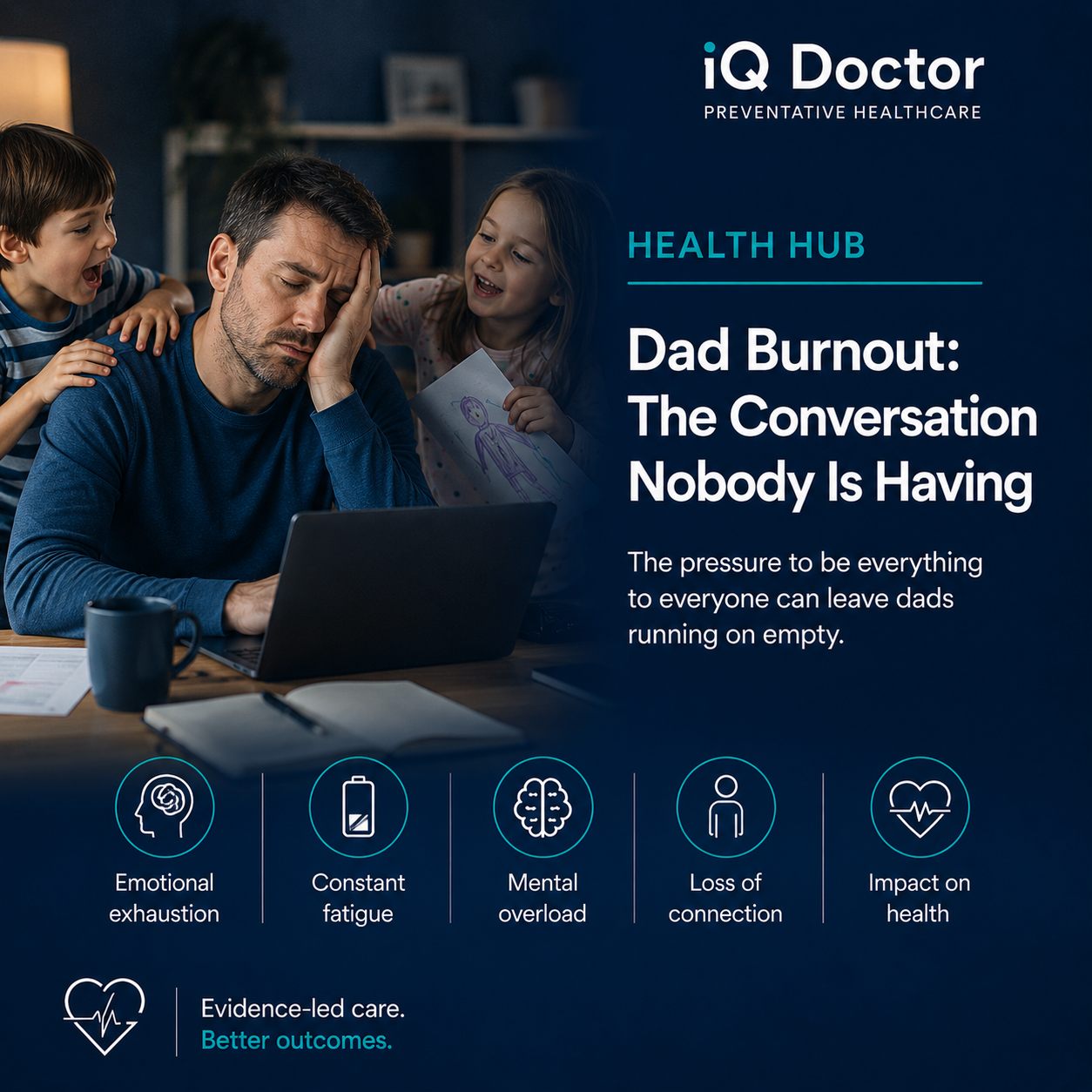
You are keeping everything moving. The job. The school runs. The mortgage. The WhatsApp groups nobody else seems to organise. The conversations your partner needs to have and the ones you are quietly putting off. The Sunday afternoons that feel strangely hollow despite being full.
You are not falling apart. But you are not quite okay, either.
That in-between place, too depleted to feel like yourself, too functional to think it counts as a problem, is where a lot of fathers quietly live. And it has a name, even if most men who experience it would not use it: burnout.
Dad burnout is not the same as depression, and it is not simply being tired. It is a state of cumulative depletion (physical, emotional and mental) that builds gradually when the demands on a man outpace his capacity to recover from them. It affects mood, sleep, metabolism, relationships and long-term health in ways that deserve proper attention rather than quiet endurance.
This article explores what dad burnout actually is, why it is so easy to miss, what is happening in the body when it takes hold, and why treating it as a preventative health issue, rather than a character flaw or a lifestyle complaint, changes everything.
What this article covers
- Why dad burnout is more than tiredness
- The physiological drivers: cortisol, testosterone and sleep
- Why fathers are particularly vulnerable in midlife
- The invisible load and its real cost to health
- Why men do not recognise burnout or ask for help
- When exhaustion becomes a preventative health concern
- What recovery and clinical support can look like
It is not weakness. It is depletion.
Burnout is not a new concept, but it has historically been discussed in workplaces, or in the context of caring professions, or in relation to mothers. Fathers have rarely featured in that conversation, not because they do not experience it, but because the expectations placed on men make it harder to name.
The clinical understanding of burnout describes it as a state of chronic stress that has not been adequately recovered from, characterised by emotional exhaustion, a sense of detachment or disconnection, and a reduced sense of effectiveness (1). Those three features map closely onto what many fathers in their late 30s, 40s and early 50s describe when they are honest about how they feel.
What makes dad burnout distinct is not just the volume of demands, but the combination of them. Work pressure at peak career intensity. Financial responsibility that feels unrelenting. Parenting that requires emotional availability at precisely the moments when emotional reserves are lowest. A relationship that needs attention that there is no longer enough of. And underneath all of it, the quiet assumption that this is simply what being a responsible man looks like.
That assumption is worth questioning. Because the cost of sustained depletion is not just personal. It is measurable, physiological and, in the long run, a genuine health risk.
What dad burnout actually looks like
Burnout in fathers rarely presents as collapse. It presents as a slow narrowing. The things that used to feel enjoyable gradually feel like effort. Patience (already stretched thin) runs out faster. Energy that used to return after a night's sleep no longer does.
Common presentations include:
- Persistent fatigue that rest does not fully resolve
- Reduced enjoyment of activities that once brought satisfaction
- Emotional flatness, or a sense of going through the motions
- Increased irritability, particularly at home, often followed by guilt
- Difficulty being present - physically there but mentally elsewhere
- A withdrawal from social connection or things done purely for pleasure
- Disrupted sleep - difficulty falling asleep, waking at 3am, or sleeping heavily but still exhausted
- A low-grade sense of resentment or overwhelm that feels impossible to voice
- Reduced motivation or difficulty concentrating at work
What makes these symptoms easy to overlook is that they are often indistinguishable, from the outside, from simply being a busy father. The man experiencing them is still functioning. He is still showing up. He is still, by most external measures, fine.
The gap between how he is presenting and how he actually feels is part of what sustains burnout, and part of why it can persist for years without being named.
The physiology of dad burnout: what is happening in the body
Burnout is not just an emotional state. It has clear physiological correlates, and understanding them matters because they help explain why willpower and positive thinking are insufficient as recovery strategies.
Cortisol and the chronic stress response
Cortisol is the body's primary stress hormone. In short bursts, it is functional, it sharpens focus, mobilises energy and prepares the body for demands. Sustained over months or years, however, it becomes one of the most disruptive forces in male health (2).
Chronically elevated cortisol:
- Increases generalised anxiety and lowers the threshold for the stress response
- Impairs memory, emotional context and perspective via its effects on the hippocampus
- Reduces serotonin availability, affecting mood stability
- Suppresses testosterone, compounding fatigue and emotional depletion
- Disrupts deep sleep (the most restorative stage) which makes all other symptoms worse
- Promotes fat storage, particularly around the abdomen, affecting metabolic health
For fathers in midlife carrying sustained financial, professional and relational pressure, cortisol is often chronically elevated. The body does not distinguish between a difficult board meeting and a difficult conversation with a teenager. The load accumulates, and the physiological cost is real.
Testosterone and the motivation engine
Testosterone declines gradually from the mid-30s onwards, at roughly one to two percent per year (3). On its own, that rate of decline is manageable. But combined with the cortisol suppression that accompanies chronic stress, the decline can be more pronounced and more impactful than the numbers suggest.
Testosterone supports the brain's dopamine and reward systems, the neurochemical pathways most associated with drive, motivation and the anticipation of pleasure. When levels decline, men often describe not sadness but a kind of dulling. Things feel less worth doing. The instinct to initiate, to pursue, to engage, quietly diminishes.
For a father who used to feel energised by ambition and engagement, this can feel like a personality change. It is not. It is a physiological shift that responds to the right kind of clinical attention.
Sleep and the recovery deficit
Sleep is the body's primary mechanism for recovery, physical, cognitive and emotional. For fathers in midlife, sleep quality is frequently compromised in ways that go beyond simple tiredness.
Deep non-REM sleep, which declines naturally from the mid-30s, is when the brain processes the emotional residue of the day, consolidates memory and clears metabolic waste products associated with mood regulation (4). Fathers who describe sleeping seven hours but waking unrefreshed are often experiencing exactly this: the hours are there, but the restorative architecture is not.
Early-morning waking, often accompanied by low-level anxiety or a sense of dread, is a common feature of both cortisol dysregulation and disrupted sleep structure. It reflects a physiological state, not a psychological failing.
Alcohol is worth naming here directly. Many fathers use alcohol in the evenings to decompress, and it is effective at inducing sleep onset. But it significantly suppresses REM and deep sleep in the second half of the night, the stages most critical for emotional processing and recovery (5). Regular evening drinking, even in modest amounts, can quietly worsen the very sleep quality that burnout recovery depends on.
If you are wondering whether what you are experiencing might have a clinical explanation, a proper assessment is a good place to start.
Our team works with men in midlife who are not quite themselves and want to understand why. No pressure. No judgement.
The invisible load: why fatherhood is a particular kind of exhaustion
The concept of emotional labour, the ongoing mental and emotional work of managing relationships, anticipating needs, tracking responsibilities and maintaining the household's functioning has been discussed at length in the context of mothers. It is less commonly applied to fathers, even as the expectations placed on them have shifted significantly.
Modern fatherhood carries a specific emotional load that previous generations did not fully share. Being a present and emotionally engaged father, a reliable financial provider, a supportive partner, a functioning professional and a socially connected person simultaneously requires a form of sustained self-management that is genuinely demanding.
Research examining paternal stress has found that fathers experience significant psychological load related to work-family conflict, financial pressure and role ambiguity, the tension between what they feel they should be doing and what they actually have capacity for (6). That ambiguity, and the guilt it generates, is its own source of depletion.
Unlike many forms of occupational burnout, where recovery happens by stepping away from the source of stress, dad burnout has no clear off switch. The demands do not pause. The home that is meant to be the place of recovery is also the place of responsibility.
Why fathers do not name this and what it costs
There are several reasons why dad burnout goes unspoken, and most of them are culturally familiar.
Men are less likely to identify emotional or physical exhaustion as something worth seeking help for. Persisting has historically been positioned as both practical and virtuous. The vocabulary for describing emotional depletion (burnout, exhaustion, overwhelm) can feel incompatible with the identity of someone who provides and protects.
But there is another layer that is less often acknowledged: many fathers genuinely do not recognise what they are experiencing as a health issue. They know they are not quite right. They attribute it to circumstances a difficult patch at work, a stressful period, something they will get on top of when things settle down.
The difficulty is that things rarely settle down. The demands of midlife fatherhood tend to continue at roughly the same intensity for a sustained period. And the physiological changes happening underneath declining testosterone, elevated cortisol, deteriorating sleep quality, do not resolve by waiting.
The cost of that delay is measurable. Sustained burnout is associated with increased risk of cardiovascular disease, metabolic dysfunction, immune suppression and significantly elevated risk of clinical depression and anxiety (7). What begins as fatigue and emotional flatness becomes, over time, a genuine threat to long-term physical and mental health.
None of this is about blame. It reflects a genuine gap in how men are supported to understand their own health, particularly the relationship between the mental and the physical, and between sustained stress and long-term wellbeing.
Dad burnout as a preventative health conversation
The framing of burnout as a mental health issue can inadvertently make it harder for men to engage with. It activates the same resistance as any mental health conversation the sense that it is not serious enough, not clinical enough, not quite the right category.
A more useful frame, for many fathers, is preventative health. The physiological changes associated with sustained burnout, hormonal disruption, sleep architecture deterioration, metabolic dysregulation, have downstream consequences for cardiovascular health, cognitive function, metabolic health and immune resilience. Addressing them early is meaningfully different from waiting until they produce a diagnosable condition.
That shift in framing changes what counts as a valid reason to seek support. It is not about being unable to cope. It is about maintaining the biological systems that long-term health depends on, at a point in life where those systems are under genuine and sustained pressure.
Concrete areas that a clinical approach to dad burnout might address include:
- Sleep quality and structure: not just duration, but the restorative architecture of sleep and how to support it
- Cortisol and stress load: identifying what is physiologically happening and what can practically be modified
- Testosterone levels: particularly where fatigue, low motivation and emotional flatness are prominent symptoms
- Metabolic markers: weight, energy regulation and the relationship between fatigue and metabolic health
- Nutritional status: vitamin D, B12 and iron deficiencies that frequently contribute to fatigue and mood changes
- Alcohol use: its relationship to sleep quality and recovery, without judgement
Recovery from burnout is not just about rest. It requires understanding what is actually driving the depletion, and addressing it. A clinical assessment that looks at hormones, sleep, stress and metabolic health together gives a far more complete picture than any single-lens approach.
What recovery from dad burnout actually looks like
Genuine recovery from burnout is not about taking a holiday or working fewer hours, although both may help at the margins. It is about addressing the underlying physiological state that has accumulated over years of sustained demand.
For most fathers, that means a combination of things rather than any single intervention.
Sustainable sleep improvement is typically the highest-leverage change available. Not in terms of hours alone, but in terms of supporting the deep, restorative sleep stages that have been gradually eroded. This often requires addressing evening habits, alcohol use, light exposure, stress management practices and, where indicated, clinical support for conditions like sleep apnoea that disrupt architecture from the inside.
Stress load reduction is not the same as stress elimination. For most fathers, the stressors themselves are not going away. The goal is reducing the physiological activation they produce through movement, recovery practices, cognitive reframing and, where appropriate, clinical support for the cortisol dysregulation that has taken hold.
Social and relational reconnection is frequently a casualty of burnout, and also one of the most reliable routes out of it. Fathers in burnout often withdraw from friendships and activities that have no instrumental purpose. Those connections are not luxuries. Research consistently identifies social support as one of the most potent protective factors against sustained physiological stress (8).
And for a meaningful proportion of fathers, clinical assessment will identify hormonal or metabolic factors that lifestyle change alone cannot fully address. Low testosterone, thyroid dysfunction, significant nutritional deficiencies and clinical sleep disorders are all genuinely treatable and genuinely common in this population.
Why "just exercise more and talk to someone" often misses the mark
Exercise is valuable. Talking is valuable. Neither of those statements is contested. But applied without understanding the physiological context of a man who is chronically cortisol-elevated, sleep-deprived and hormonally depleted, they can feel both inadequate and defeating.
Telling an exhausted father to go to the gym regularly requires a reservoir of energy and motivation that burnout specifically depletes. Telling him to open up to friends requires a social infrastructure that burnout has often quietly dismantled. The advice is not wrong. The sequencing is.
A clinical approach that first addresses the physiological state that creates the conditions in which motivation, energy and connection can actually function is more likely to make those recommendations effective. Biology is not a barrier to recovery. It is the starting point for it.
Frequently asked questions
Is dad burnout the same as depression?
Not the same, but not entirely separate either. Clinical depression is a specific diagnosis with defined criteria. Burnout is a state of cumulative depletion: emotional, physical and mental which can occur without meeting the threshold for depression, but that shares many of its features and, if left unaddressed, significantly increases the risk of developing it (1). Both deserve clinical attention. Neither is simply a failure of effort.
How do I know if I'm burnt out or just tired?
Ordinary tiredness resolves with rest. Burnout does not. If you are consistently waking unrefreshed, finding that recovery does not reset you the way it used to, and noticing a persistent reduction in motivation, enjoyment or emotional availability over a period of weeks or months, that pattern is worth taking seriously. Burnout typically has a sustained, progressive quality that distinguishes it from situational fatigue.
Can burnout affect physical health, not just mental health?
Yes, significantly. Sustained burnout is associated with elevated cortisol, which directly affects cardiovascular health, immune function, metabolic regulation and sleep quality (2). The physiological and the psychological are not separate systems. Burnout is a whole-body state, and its long-term health consequences go beyond mood and motivation.
Why do I feel more irritable with my family when I'm most depleted?
When cortisol is chronically elevated and sleep quality is poor, the prefrontal cortex, the brain region responsible for emotional regulation and impulse control, functions at reduced capacity (4). The result is a lower threshold for frustration and a slower recovery from it. This is not a character shift. It is a physiological symptom of depletion. The guilt that typically follows is real, but the cause is biological rather than moral.
What is the relationship between burnout and testosterone?
Chronic cortisol elevation directly suppresses testosterone production (3). So, burnout does not just feel like low testosterone, it can actively drive it. And because testosterone supports the brain's reward and motivation systems, the resulting dopamine dysregulation creates a feedback loop: depletion reduces motivation, which makes recovery behaviours harder to maintain, which sustains the depletion.
When should I seek clinical support?
If the pattern of fatigue, emotional flatness, disrupted sleep or reduced motivation has persisted for more than a few weeks, is affecting your relationships or your work, or is not improving despite reasonable lifestyle adjustments, a clinical assessment is worthwhile. You do not need to be at crisis point to deserve support. Earlier assessment generally means more options and a shorter route back to feeling like yourself.
Can addressing physical health improve dad burnout?
Frequently, yes. When the physiological drivers of burnout cortisol dysregulation, testosterone decline, sleep disruption, nutritional deficiencies are identified and addressed, men often report significant improvements in energy, mood, motivation and emotional resilience alongside any physical changes. The body and the mind are not separate systems. Addressing one routinely benefits the other.
The most demanding job most men are doing is the one nobody is assessing
Fatherhood in midlife is one of the most sustained, multi-dimensional demands a man will face. It asks for financial reliability, emotional presence, physical energy, professional performance and relational attentiveness, all simultaneously, and largely without acknowledgement.
The exhaustion that accumulates in that context is not weakness, and it is not inevitable. It is a physiological response to sustained demand without adequate recovery. And it has real, measurable drivers (hormonal, metabolic, neurological) that deserve the same clinical attention as any other health issue.
Understanding that the problem is real, that it has identifiable causes and that those causes can often be addressed, changes the conversation from one about endurance to one about health. And that shift (from pushing through to taking stock) is often where genuine recovery begins.
References
- Maslach C, Leiter MP. Understanding the burnout experience: recent research and its implications for psychiatry. World Psychiatry. 2016;15(2):103–11. Available from:https://doi.org/10.1002/wps.20311
- McEwen BS. Neurobiological and systemic effects of chronic stress. Chronic Stress (Thousand Oaks). 2017;1:2470547017692328. Available from:https://doi.org/10.1177/2470547017692328
- Harman SM, Metter EJ, Tobin JD, Pearson J, Blackman MR. Longitudinal effects of aging on serum total and free testosterone levels in healthy men. J Clin Endocrinol Metab. 2001;86(2):724–31. Available from:https://doi.org/10.1210/jcem.86.2.7219
- Walker MP. Why We Sleep: The New Science of Sleep and Dreams. London: Penguin Books; 2018.
- Ebrahim IO, Shapiro CM, Williams AJ, Fenwick PB. Alcohol and sleep I: effects on normal sleep. Alcohol Clin Exp Res. 2013;37(4):539–49. Available from:https://doi.org/10.1111/acer.12006
- Aumann K, Galinsky E, Matos K. The New Male Mystique. Families and Work Institute; 2011. Available from: https://www.familiesandwork.org/the-new-male-mystique
- Salvagioni DAJ, Melanda FN, Mesas AE, González AD, Gabani FL, Andrade SM. Physical, psychological and occupational consequences of job burnout: a systematic review of prospective studies. PLoS One. 2017;12(10):e0185781. Available from:https://doi.org/10.1371/journal.pone.0185781
- Umberson D, Montez JK. Social relationships and health: a flashpoint for health policy. J Health Soc Behav. 2010;51 Suppl:S54–66. Available from:https://doi.org/10.1177/0022146510383501
Our Clinical Authors
This page has been written by a registered UK pharmacist and reviewed by our clinical team to ensure it is accurate, clear and reflects current clinical guidance.
Last medically reviewed: 12 June, 2026
Last updated: 18 September, 2026