Should I tell my partner I am taking weight loss medication?
06 July, 2026 | Jabbar Ali - MPharm
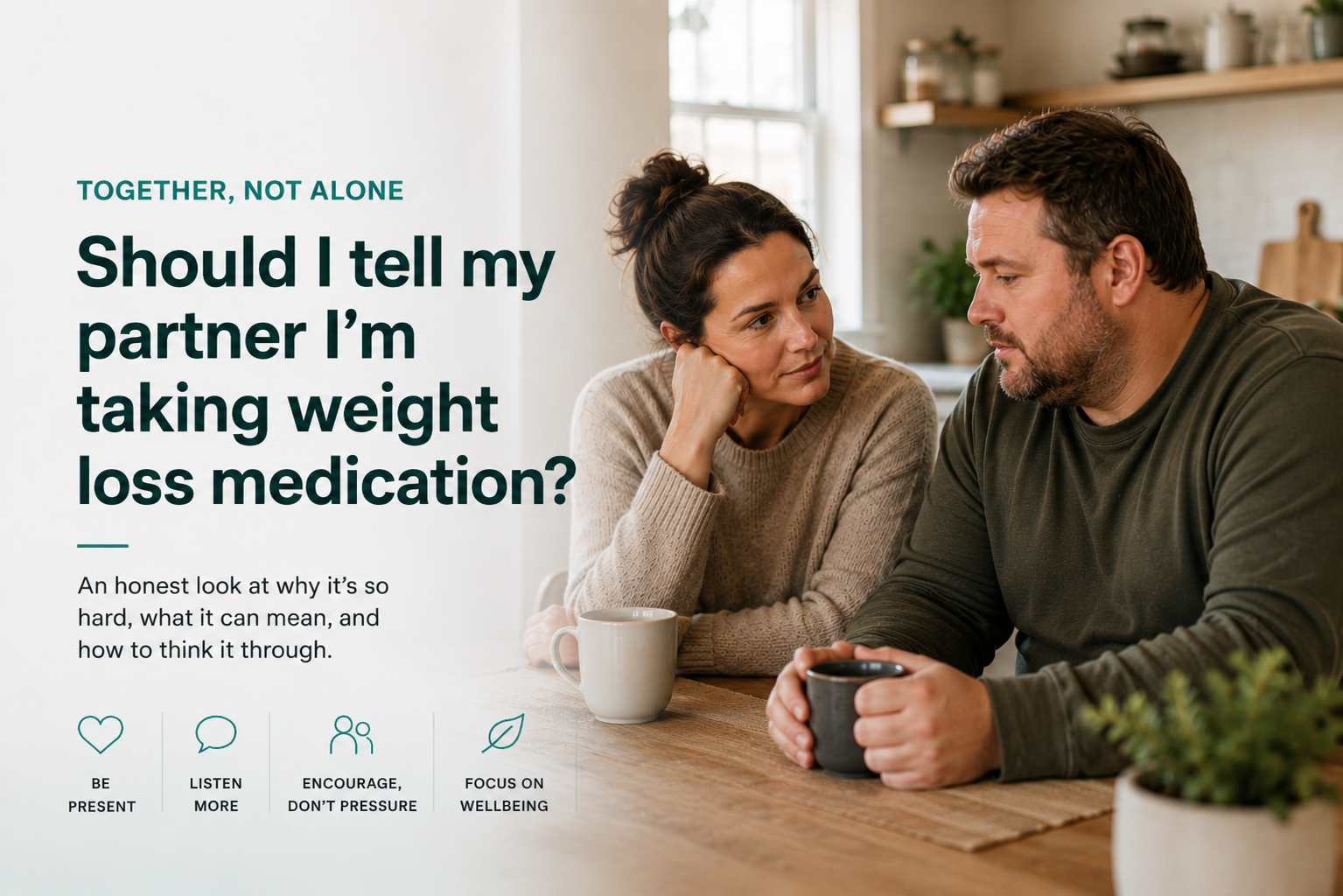
She has been using it for eight weeks. Her clothes fit differently. She feels less controlled by food than she has in years. And every morning, when she takes her injection, she closes the bathroom door first.
Her partner has not asked. She has not told him. She is not sure what she would say if he did.
This is not a story about deception. It is a story about how difficult it can be to talk about your own body, your own health, and your own choices, even with the person who is closest to you. Especially, sometimes, with that person.
Across the UK, a significant proportion of people using GLP-1 weight loss medications like semaglutide and tirzepatide have not disclosed this to their partner. The reasons are varied, human, and understandable. But the question of whether to tell a partner is one that many people sit with alone, without good information or a useful framework for thinking it through.
This article is an attempt to provide that. Not a prescription for what you should do, that is genuinely your decision, but an honest look at why the question is hard, what different choices tend to involve, and how treatment can interact with a relationship in ways that are worth knowing about in advance.
We will also say this clearly at the outset: we are going to write a more dedicated article about weight loss medication and relationships, because it is a topic that deserves fuller treatment. This article focuses on the disclosure question specifically: whether to tell your partner, and how to think that through.
What this article covers
- Why so many people keep weight loss treatment private from their partner
- The different reasons people don’t tell, and why they matter
- What keeping treatment secret from a partner can involve
- How weight loss treatment can affect a relationship
- The case for telling your partner
- The case for not telling (and why it’s sometimes valid)
- How to have the conversation if you decide to
- What the clinical team needs to know regardless
Why so many people keep weight loss treatment private from their partner
The secrecy around weight loss medication is well documented. We have explored it in an earlier article, and the data is striking: surveys consistently find that a majority of people using GLP-1 treatments have not disclosed this to people in their personal lives.(1) What is less often examined is that this secrecy frequently extends to partners specifically, not just to acquaintances or colleagues, but to people with whom someone shares their daily life.
That can seem paradoxical from the outside. A partner is usually the person we are most open with about our health. They notice changes in our body. They share meals with us. They may be the first person we would call if something went wrong medically. And yet, when it comes to weight loss treatment, the partner is often the last person told, or not told at all.
Part of this is the specific nature of the stigma around weight. We are talking about a condition that our culture has persistently framed as a personal failing, and a treatment that the same culture has often described as cheating. When that stigma lives outside us in the form of social judgement, it is manageable. When it might live inside our closest relationship when the person whose opinion of us matters most might turn out to hold those beliefs, the stakes are much higher.
The fear is not always rational, in the sense that it is not always grounded in evidence about what the partner actually thinks. But it is always understandable.
The different reasons people don’t tell and why they matter
Understanding why you have not told your partner, or why you are hesitating, is useful, because the different reasons point toward different things. They are not interchangeable.
Fear of judgement
The most common reason. A worry that the partner will think less of you for using medication. That they will see it as weakness, as a shortcut, as something you should not need. This fear often has less to do with what the partner has actually said and more to do with messages about weight that have accumulated over years, sometimes from family, sometimes from previous relationships, sometimes from the culture more broadly.
If this is the primary reason for not telling, it is worth asking whether the belief is based on evidence. Has this partner said things that suggest they would react this way? Or is the expectation inherited from elsewhere?
Wanting to own the change
Some people keep treatment private not from shame but from a desire for the change to feel like theirs. The wish to see whether it works before telling anyone. The sense that involving a partner at this stage , before the outcome is known, would feel premature, or would mean sharing something that is not yet fully formed.
This is a different kind of privacy: one rooted in self-possession rather than shame. It is worth recognising, because how you handle it differently, it is not a problem to solve but a preference to understand.
Protecting the relationship from complexity
For some people, the concern is not about their partner’s reaction to the medication specifically, but about the conversations it might open. About body image, about food, about shared history with weight and eating. Those are not easy conversations, and the medication can feel like a door that, once opened, leads somewhere complicated.
The desire to keep the relationship in its current form, to not introduce a topic that might change the dynamic, is a recognisable human impulse. It is also one worth examining, because sometimes the conversations we most want to avoid are the ones that would change things for the better.
Uncertainty about the relationship itself
Occasionally, what someone discovers when they sit with this question is that the reason they cannot imagine telling their partner is not about the medication at all. It is about the relationship — a sense that it is not a safe space for vulnerability about health or body or self. That is important information, and it belongs in a different conversation, possibly including with a relationship counsellor.
What keeping treatment secret from a partner can involve
It is worth being honest about the practical and emotional texture of this, because it is often underestimated at the outset.
Injectable weight loss medications, currently the most widely prescribed form in the UK, require weekly administration, a storage solution, and in some cases sharps disposal. These are not things that are easy to manage invisibly inside a shared home. Partners open fridges. They notice changes in the bathroom cabinet. They ask about bruises. The logistical management of secrecy is real and ongoing, and it creates a low-level background stress that people often do not fully anticipate.
Beyond the logistics, there is the relational texture. Sharing a life with someone involves a continuous small disclosure of your inner world: how you are feeling, what you are thinking about, what is weighing on you. Carrying a significant piece of information about your health, your body, and something that is genuinely affecting your daily experience means a part of your inner world is consistently withheld. Over time, that can feel less like privacy and more like distance.
None of this is an argument that you must tell your partner. It is an argument for going into the decision with clear eyes about what sustained secrecy in a close relationship actually involves.
If you’re using or considering weight loss treatment and navigating the personal dimensions of that decision, iQ Doctor’s UK-based clinical team is here for confidential, judgement-free consultations. What you share with us stays with us.
Explore weight loss treatment at iQ Doctor
How weight loss treatment can affect a relationship
We want to touch on this briefly here, and will explore it in much more depth in a follow-up article, because the topic deserves careful and thorough treatment.
The short version is this: significant weight loss, and the process of achieving it, can change things in a relationship in ways that both partners may not be fully prepared for. This is true whether or not the treatment is disclosed.
It can change the physical dynamic. It can change the social dynamic, how you move through the world together, how others respond to you, what conversations you have. It can surface things about your relationship with food, with your body, and with yourself that have been submerged for a long time. For some couples, these changes are welcomed and navigated well. For others, they introduce a friction that was not expected.
The research on this is nuanced. Weight loss has been associated with both improvements in relationship satisfaction and, in some cases, with increased relational stress, particularly when the change is significant and one partner was not prepared for the implications.(2) The disclosure question matters partly because it affects whether your partner is walking this road with you or finding out, after the fact, that the road has already been walked.
Again, this is not an argument for mandatory disclosure. It is context. And we will come back to it properly.
The case for telling your partner
There is a meaningful body of evidence that social support improves medical treatment outcomes. People who have at least one person in their life who knows about their treatment and engages with it supportively tend to adhere more consistently, experience less psychological burden around the treatment, and feel more able to be transparent with their clinical team.(3)
A partner, in most cases, is the natural candidate for that person. They see your daily life. They share your meals. They are present for the moments when treatment is harder; nausea, fatigue, the adjustment period, the weeks when progress feels slower. A partner who knows is a partner who can accommodate, encourage, and not inadvertently make things harder.
There is also something to be said for the relational case that sits alongside the clinical one. Significant health decisions, and the changes they bring, are things that partnerships are generally better equipped to absorb together than they are to discover retrospectively. A partner who finds out some time into treatment, and who therefore understands that a decision was made and kept from them — may have a different response than one who was told at the beginning.
That is not to say the response will be bad. Many partners respond with support, relief, and practical helpfulness when told. The fear of what they might think is often larger than what they actually think.
The case for not telling and why it is sometimes valid
Your medical treatment is your business. This is not a platitude, it is a foundational principle of patient autonomy, and it applies as much within a relationship as it does outside one. You are not obligated to share health information with your partner, and choosing not to is not inherently a betrayal.
There are situations in which not telling is the clearly right call, at least for now. If the relationship has a history of your partner using health information against you — as ammunition, as a reason for criticism, as a way of diminishing you, then protecting this information is not avoidance. It is self-care.
If you are in an early stage of treatment and you want to see whether it is working before involving anyone else, that is a legitimate form of self-determination. The desire to own a health journey before sharing it is understandable and valid.
If you are in a relationship where body and weight have been a source of tension, and you need some time to establish your own relationship with this treatment before introducing the relational dimension, that is also a reasonable thing to give yourself.
The question is not whether you are allowed not to tell. You are. The question is whether not telling is a considered choice or a default, something you are actively deciding or something you are simply not getting around to addressing. Those have different implications for how you feel carrying it, and for what it may mean over time.
“In my clinical experience, the patients who find disclosure to a partner most difficult are often not afraid of their partner’s reaction; they are afraid of having to explain themselves in a context where they still feel uncertain about their own legitimacy in using treatment. The most useful thing I can offer those patients is clarity: this is a medical treatment for a medical condition, and they do not need to justify it to anyone. Including themselves.”
Omar El-Gohary, Superintendent Pharmacist, iQ Doctor
How to have the conversation if you decide to
If you have decided to tell your partner, a few things are worth thinking about in advance, not because the conversation needs to be scripted, but because going in with some clarity tends to make it go better.
Know what you want from the conversation
Are you looking for practical support? Emotional acknowledgement? Just to have them know, without any particular expectation of response? Being clear in your own mind about what you want makes it easier to steer the conversation toward something useful, and to recognise when you have got what you needed.
Lead with the health, not the weight
Framing the conversation around your health, this is a clinically prescribed treatment for a recognised medical condition, rather than your weight or appearance tends to produce better responses. It places the treatment in its correct context: medical, considered, appropriate. It reduces the surface area for the kinds of responses that can feel diminishing.
Be ready for a response that takes time to settle
Partners can respond in ways that are supportive but imperfect, with questions that feel intrusive, with comments about effort and shortcuts that they mean well but land badly, with a sudden interest in your eating that is not helpful. These responses often come from a place of not understanding what GLP-1 medications actually are and what they do. Give the conversation room to develop. A first response is not always a final one.
You do not need to explain everything at once
You are not obligated to provide a full clinical briefing in the same conversation. Telling your partner you are using weight loss medication prescribed by a doctor is enough for a first disclosure. More information can follow as the conversation develops over time.
What practical steps look like
Sit with the question before you act on it
Whether you are leaning toward telling or not telling, it is worth spending some time understanding why. What is the feeling underneath the hesitation? Is it fear of a specific reaction, or something less defined? Is it a genuine preference for privacy, or a form of shame that you would rather not carry indefinitely? Knowing the answer does not tell you what to do, but it tends to make the decision clearer.
Separate the medical question from the relational one
Whether to use weight loss treatment is a clinical decision, made with a prescriber, based on your health. Whether to tell your partner is a relational decision, made by you, based on your specific relationship. Do not let uncertainty about one contaminate clarity about the other. You can be confident in your treatment decision while still being unsure about disclosure.
Consider what sustained secrecy will feel like
Not as a source of guilt, but as information. If you imagine yourself six months from now, still managing this privately in a shared home, how does that feel? Some people find that genuinely manageable. Others find that they cannot imagine sustaining it without it costing them something. Both are valid data points.
Know that you can change your mind
Deciding not to tell right now is not a permanent decision. Many people who initially keep treatment private find that, as they become more settled in it and more confident in the changes it is producing, the conversation becomes easier to contemplate. Not telling now does not mean never telling.
Be honest with your clinical team regardless
Whatever you decide about your partner, the most important relationship to be transparent in is the clinical one. Your prescriber needs to know about your treatment, your side effects, your adherence, and any factors affecting your experience of it. That relationship is the one where full disclosure matters most for your safety and outcomes, and it is protected by professional confidentiality regardless of what you decide in your personal life.
Ready to start or continue weight loss treatment in a clinical environment that understands the full picture? iQ Doctor offers confidential, clinician-reviewed consultations with UK-registered prescribers. We are here to support the medical side of this. The rest is yours.
Start a consultation at iQ Doctor
Frequently asked questions
The following questions are answered with reference to current clinical understanding and general relational evidence. If you have specific concerns about your health or your relationship, please speak to the appropriate professional.
Am I obligated to tell my partner I am using weight loss medication?
No. Your medical treatment is your own, and patient confidentiality applies regardless of your relationship status. You are not legally or ethically required to disclose your treatment to a partner. The decision is personal and depends on your specific relationship, your reasons for hesitating, and what you feel you can sustain over time.
What if my partner finds out I have been taking weight loss medication without telling them?
This depends enormously on the relationship and on how they find out. Partners who discover treatment after the fact sometimes feel hurt by the secrecy rather than by the treatment itself. If this is a concern, it is worth weighing up what it would feel like to have that conversation proactively versus reactively, and whether there is a version of disclosure that feels manageable to you.
How might weight loss medication affect my relationship?
Significant weight loss can affect a relationship in several ways — some positive, some requiring adjustment. We are going to address this in depth in a dedicated follow-up article, because it deserves more space than a single question allows. In brief: the relational impact varies significantly depending on the couple, the degree of change, and whether both partners are navigating the process together or one is doing so alone. Having a partner who knows tends to make the relational adjustment easier.
What if my partner is unsupportive when I tell them?
This is a real possibility, and it is worth being prepared for it. Unsupportive responses often come from misunderstanding what GLP-1 medications are and what they do — from the same cultural narratives about weight and willpower that make disclosure hard in the first place. Giving the conversation time, providing clear information about the clinical basis of treatment, and separating your partner’s initial reaction from their settled position can all be helpful. If unsupportive responses persist and are affecting your wellbeing or your treatment, that may be worth exploring with a relationship counsellor.
I want to tell my partner but do not know how to start. What do I say?
A straightforward opening is often best. Something like: ‘There is something about my health I have been wanting to talk to you about. I have been prescribed medication for weight management by a doctor, and I wanted you to know.’ You do not need to have all the answers ready before you begin. The conversation can develop from there. What matters most is framing it correctly from the start: as a health decision, clinically guided, not something to be ashamed of.
Does keeping weight loss treatment secret affect the treatment itself?
It can. Research shows that patients who lack social support around their treatment are more likely to struggle with adherence, more likely to underreport side effects to their clinical team, and more likely to carry a higher psychological burden around treatment.(3) Having at least one trusted person who knows about your treatment — whether that is a partner, a friend, or a family member — tends to improve outcomes. The most important relationship to be fully transparent in is the clinical one.
Should I wait until I have lost weight before telling my partner?
This is a common instinct — wanting to have a result to point to before the conversation. There is nothing wrong with it as a preference. However, it is worth being aware that waiting until change is visible means your partner has already been observing that change without knowing its context. Whether that matters will depend on your relationship. Some couples navigate this easily. Others find the retrospective disclosure more complicated than an earlier one would have been.
References
- Puhl RM, Himmelstein MS, Pearl RL. Weight stigma as a psychosocial contributor to obesity. Am Psychol. 2020;75(2):274–289. Available from: https://doi.org/10.1037/amp0000538
- Lefebvre P, Duh MS, Buteau S, et al. Burden of illness of obesity on relationships and sexual function. Obes Facts. 2021;14(4):377–386. Available from: https://doi.org/10.1159/000516151
- DiMatteo MR. Social support and patient adherence to medical treatment: a meta-analysis. Health Psychol. 2004;23(2):207–218. Available from: https://doi.org/10.1037/0278-6133.23.2.207
- Wharton S, Lau DCW, Vallis M, et al. Obesity in adults: a clinical practice guideline. CMAJ. 2020;192(31):E875–E891. Available from: https://doi.org/10.1503/cmaj.191707
Our Clinical Authors
This page has been written by a registered UK pharmacist and reviewed by our clinical team to ensure it is accurate, clear and reflects current clinical guidance.
Last medically reviewed: 06 July, 2026
Last updated: 18 September, 2026