How Men Experience Hair Loss Differently: The Psychology of Male Pattern Baldness
07 August, 2026 | Jabbar Ali - MPharm
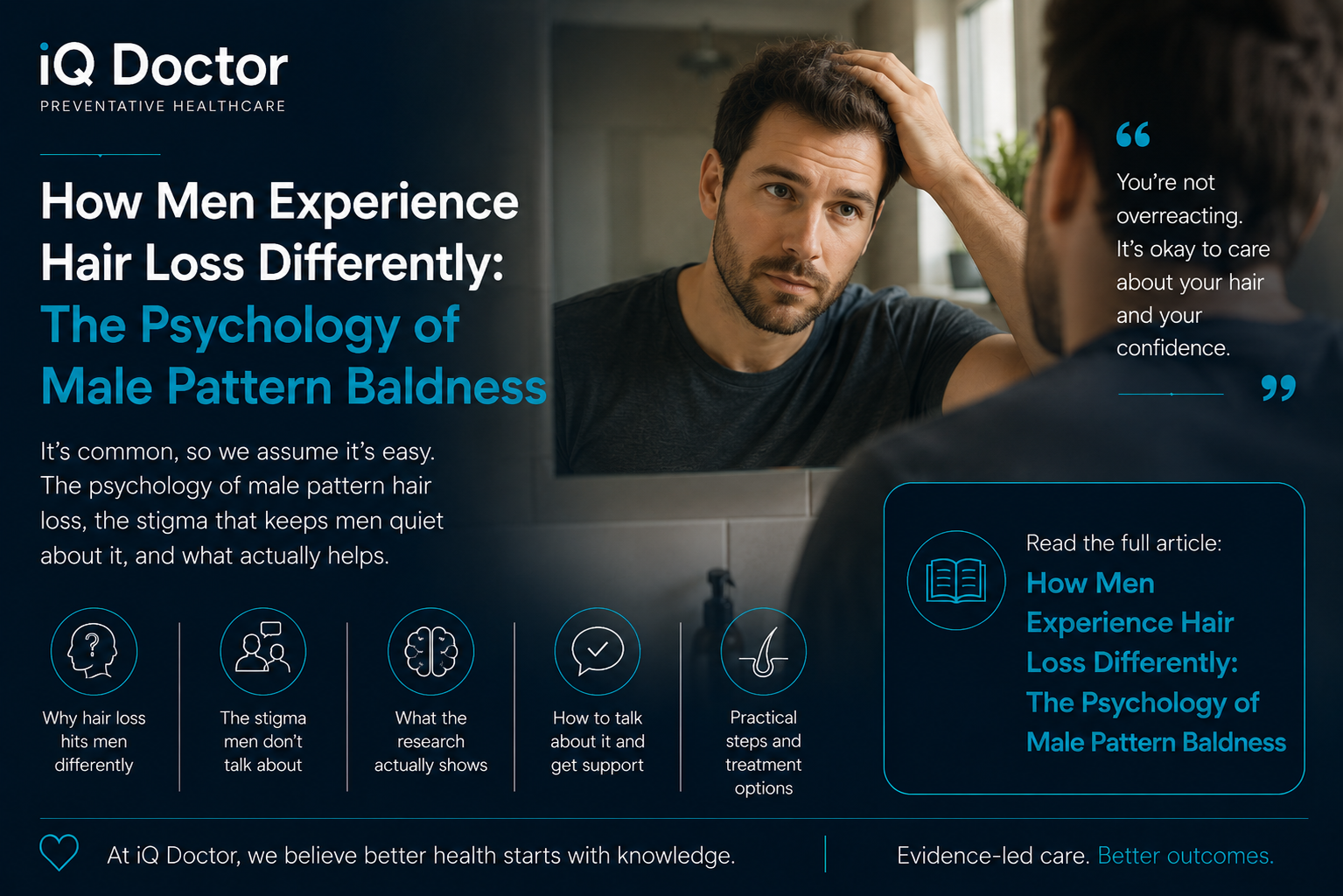
Losing your hair as a man is supposed to be no big deal. It's genetic, it's extremely common, and there's a ready-made cultural script for the moment it starts: shave it off, own it, joke about it, move on. For plenty of men, that script works fine, and there's nothing wrong with that.
For plenty of others, it doesn't work quite so neatly, and that's rarely given much space. The assumption that male pattern hair loss is simply ‘a thing that happens’ means the men who do find it genuinely difficult often have nowhere obvious to put that feeling, and little permission to raise it without it being read as vanity or an overreaction.
This article looks at what makes the male experience of hair loss genuinely different: the stigma that frames it as something you're not supposed to mind, what the research actually shows about its psychological impact, and what tends to help.
What this article covers
- Why male pattern hair loss carries a different kind of social permission than hair loss in women
- What the research actually shows about its psychological impact, and why it's more mixed than either ‘it's devastating’ or ‘it's nothing’ suggests
- Why earlier onset changes the experience, from dating to career stage
- Practical ways to talk about it, with partners, friends and colleagues
- Where this fits alongside understanding the causes and exploring treatment
‘Just genetics, mate’: the permission problem
Ask most men why they're not more bothered by losing their hair, and ‘it's just genetics’ tends to come up almost immediately. It's true, and it's also doing a lot of quiet work as social armour.
Framing hair loss purely as a fact of biology, rather than something a person might reasonably have feelings about, is one of the main ways it gets waved off before anyone has to sit with how it actually feels.
Research into how baldness is discussed culturally backs this up. A recent international survey of over 350 balding men found that baldness is widely framed, by culture, advertising and even some professional research, as something men should simply accept, and that roughly two in five participants had nonetheless internalised real distress about it, describing feelings ranging from reduced confidence to dread about the future.(1)
A similarly sized group described feeling largely unaffected, genuinely rather than performatively.(1)
Both groups exist, and both are telling the truth about their own experience. What's often missing is a middle ground, where a man can say hair loss bothers him some days and not others, without that being read as either an overreaction or proof that ‘it's not that deep.’
What the research actually shows (and why it's more complicated than either side thinks)
It would be convenient to say the science proves male hair loss is just as psychologically significant as any other visible change in appearance, mirroring how this conversation has developed for women.
The evidence doesn't quite support that, and being straightforward about the complexity matters more than reaching for the tidiest version of the story.
A meta-analysis pooling data from more than 6,000 men with androgenetic alopecia found a real but moderate impact on quality of life, with no measurable average increase in depression or reduction in self-esteem compared to men without hair loss.(2)
A separate systematic review reached a similar conclusion: some individual studies report significant distress, but a meaningful number find average or better mental health among balding men, and the overall picture sits closer to moderate than severe.(3)
A large Finnish population study following men in their mid-thirties found no significant association at all between hair loss and depression, anxiety or sexual wellbeing, a result the researchers noted ran contrary to some earlier findings.(4)
None of this means hair loss doesn't affect some men significantly; it clearly does.
It means the population average doesn't predict any individual man's experience, and self-reported research in this area may itself be shaped by the same stigma being described here: men who've absorbed the message that this shouldn't bother them may simply be less likely to say that it does, on a questionnaire or anywhere else.(1)
The most honest reading of the evidence is that male hair loss distress is real and significant for a meaningful proportion of men, genuinely minor for another meaningful proportion, and that neither group has got their own experience wrong.
Earlier, and often alone: why timing changes things
One of the clearest differences between how men and women tend to experience hair loss is when it starts. Male pattern hair loss can begin in the late teens or early twenties, well before most of the life events, dating, early career, moving away from home, that are typically still ahead rather than underway.
That timing matters, because it means many men are managing a visible change to their appearance at exactly the point they're navigating adult dating for the first time, interviewing for early-career roles, or working out who they are outside their family and education.
There's rarely a peer nearby who's dealt with it yet, and even less often a script for talking about it that doesn't default straight to a joke.
What actually helps: from banter to real conversation
Among male friends, hair loss is often processed through humour long before, if ever, it's discussed properly, and that's not automatically a bad thing.
Research into how young men cope with early hair loss has found that an accepting, matter-of-fact stance is linked to better psychological adjustment than concealment alone, and for a lot of men, banter is simply how that acceptance gets performed socially.(5)
The difficulty is when the joke is the only register available, and there's no way to say, even just once, that it's actually getting to you.
With a partner, it's often less fraught than it feels in advance. Stigma research has consistently found that once someone has other information about a person, personality, how they carry themselves, whether they're kind, baldness stops carrying much weight in how attracted people feel to them.
Saying plainly that it's been on your mind, rather than downplaying it or over-explaining, tends to invite a more useful response than either silence or joking it off.
In dating, timing is a personal call rather than an obligation. There's no requirement to raise it before meeting someone, and most men find it matters far less to a new partner than it does in their own head beforehand.
At work, it essentially never needs mentioning at all, though shaving it short or embracing a fuller cut earlier rather than fighting a receding hairline is, for many men, less a concession than simply a good look.
If hair loss is contributing to persistent low mood, anxiety, or you're avoiding social situations, dating or photos because of it, that's worth taking seriously with your GP; not because hair loss itself needs fixing psychologically, but because that level of impact deserves proper support regardless of what's causing it.
Organisations such as CALM and Alopecia UK also offer support geared toward this, if talking to a professional feels like a bigger first step than you're ready for.
“Men often come to us having quietly looked into treatment for months before mentioning it to anyone, because the culture around male hair loss doesn't leave much room for it to be a big deal. I'd genuinely rather a man told us he wanted support with how he was feeling about it, not just the tablets, if that's what he actually needed.”
Omar El-Gohary, Superintendent Pharmacist, iQ Doctor
Where this fits alongside cause and treatment
This article has deliberately focused on the psychological and social side of male hair loss, rather than repeating ground covered elsewhere.
If you haven't yet worked out what's likely causing your hair loss, or want to understand the treatment options available, from finasteride through to minoxidil, our article Causes, Treatment & Prevention of Male Pattern Baldness is the place to start.
Ready to start, or continue, treatment?
iQ Doctor offers confidential, clinician-reviewed consultations with UK-registered prescribers, whatever stage of this you're at.
Start a consultation at iQ Doctor
Frequently asked questions
The following questions are answered with reference to current understanding of the emotional and social impact of male hair loss. If you have specific concerns about your health, please speak to a qualified healthcare professional.
Is it normal for hair loss to bother me even though it's really common?
Yes. How common a condition is has no bearing on how reasonable it is to have feelings about it. Research suggests a meaningful proportion of men experience real distress about hair loss, and a similarly sized group don't. Both are normal responses.
Why does everyone act like hair loss doesn't matter for men?
Largely cultural stigma and framing. Hair loss is often described as ‘just genetics’ or something to simply accept, which can make it harder to acknowledge when it does affect you, even though the research shows the emotional impact varies considerably between men.
Does research actually show hair loss affects men's mental health?
The picture is mixed. Some studies find a moderate impact on quality of life, while several large studies have found no significant average link to depression or anxiety. This means the average experience is more moderate than commonly assumed, but it doesn't rule out a real impact for individual men.
At what age does male pattern hair loss usually start?
It can begin as early as the late teens or early twenties, and becomes increasingly common through a man's thirties, forties and beyond. Earlier onset means many men are dealing with it alongside dating and early career stages, rather than later in life.
Should I tell people I'm losing my hair?
That's entirely your choice. Many men find that saying it plainly to a partner, friend or colleague, rather than downplaying or joking it away entirely, takes some of the pressure off. There's no obligation to discuss it with anyone, including at work.
When is it worth speaking to someone about how I feel about my hair loss?
If it's contributing to persistent low mood, anxiety, or you're avoiding social situations, dating or photos because of it, it's worth speaking to your GP. Organisations such as CALM and Alopecia UK can also help if you want support before or alongside that.
References
-
Jankowski GS, Kranz D, Razum J. Men's baldness stigma: a mixed methods international survey. J Health Psychol. 2024;30(5):1069–1088. Available from:
https://doi.org/10.1177/13591053241259730
-
Huang CH, Fu Y, Chi CC. Health-related quality of life, depression, and self-esteem in patients with androgenetic alopecia: a systematic review and meta-analysis. JAMA Dermatol. 2021;157(8):963–970. Available from:
https://doi.org/10.1001/jamadermatol.2021.2196
-
Frith H, Jankowski GS. Psychosocial impact of androgenetic alopecia on men: a systematic review and meta-analysis. Psychol Health Med. 2024;29(4):822–842. Available from:
https://doi.org/10.1080/13548506.2023.2242049
-
Järvinen A, Jokelainen J, Huilaja L, Sinikumpu SP. Association of male androgenetic alopecia with psychosocial and sexual well-being in early middle-aged men: a Northern Finland Birth Cohort 1986 study. Acta Derm Venereol. 2025;105:adv43457. Available from:
https://doi.org/10.2340/actadv.v105.43457
-
Kranz D. Young men's coping with androgenetic alopecia: acceptance counts when hair gets thinner. Body Image. 2011;8(4):343–348. Available from:
https://doi.org/10.1016/j.bodyim.2011.06.006
Our Clinical Authors
This page has been written by a registered UK pharmacist and reviewed by our clinical team to ensure it is accurate, clear and reflects current clinical guidance.
Last medically reviewed: 07 August, 2026
Last updated: 07 August, 2026