Life after food noise: what many people experience when appetite changes
21 July, 2026 | Jabbar Ali - MPharm
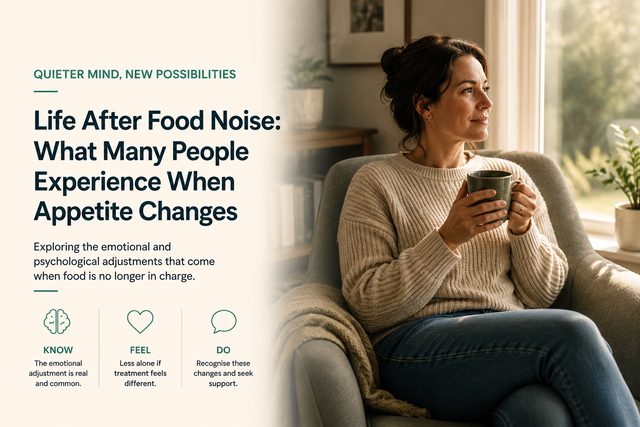
She is six weeks into treatment. The nausea has settled. The weight is moving. And something else has happened that she is finding harder to describe.
The noise has gone.
Not literal noise. The noise in her head. The constant low-level preoccupation with food that she had lived with for so long she had stopped noticing it was there until, suddenly, it wasn't. The involuntary planning of the next meal while she was still eating the current one. The quiet negotiating and managing and monitoring that used to run beneath every day like background static. Gone, or near enough to gone that the contrast is startling.
She had expected to feel relieved. She does. But she also feels something she had not expected: a kind of blankness in moments that used to be occupied. A reaching for something that is no longer there. An awareness that she used to turn to food in ways she had not fully accounted for, and that without that option available in the same way, she is not entirely sure what to do instead.
This experience; the adjustment that comes after food noise quiets, is one of the most reported and least prepared-for aspects of GLP-1 treatment. It does not mean treatment is going wrong. In many cases it is evidence that it is working. But understanding what is happening, and why it can feel unexpectedly complicated, matters.
In this article I want to explore what food noise actually is, what happens psychologically when it reduces, and how to navigate the space it leaves behind.
What this article covers
- What food noise is and why it matters clinically
- What happens when the noise goes quiet
- Why food was doing more than feeding you
- The emotional coping mechanisms that surface when appetite changes
- Identity and habit: who are you when food is no longer central?
- The opportunities that emerge in the quieter space
- When to seek support and what kind helps
What food noise actually is
The phrase 'food noise' has become more widely used in recent years, largely as a result of people trying to describe something that, until recently, had no common clinical name. It refers to the persistent, intrusive thoughts about food that many people with obesity experience as an unwanted background presence in their daily lives.(1)
Food noise is not hunger in the conventional sense. It is not the straightforward biological signal that the body needs fuel. It is more pervasive and more exhausting than that: a running mental commentary about what to eat, when to eat, what was eaten already, whether that was too much, what is in the cupboard, what the evening meal might be, whether there is something to eat nearby. A loop that operates at varying intensities but rarely fully stops.
For people who do not experience it, this can be difficult to understand. The assumption is that thinking about food is simply what happens when you are hungry, and that it stops when you eat. For many people with obesity, and particularly those with a longer history of dieting and weight cycling, that is not how it works. The thoughts about food are not reliably connected to hunger, and eating does not reliably resolve them. They operate on their own neurological logic, driven by reward circuitry, habit, emotion and a complex history with food that goes back decades.(2)
GLP-1 medications act, in part, on precisely this system. GLP-1 receptors exist not only in the gut but in the brain, including in the regions associated with reward, motivation and appetite regulation.(3) When people describe the food noise going quiet on Mounjaro or Wegovy, they are not describing a willpower victory. They are describing a change in the neurological signal that was generating the noise in the first place. The quiet is pharmacological. And for many people, encountering it for the first time in adult life is genuinely disorienting.
What happens when the noise goes quiet
The first thing many people feel when food noise reduces is relief. This is the response that weight loss treatment advertising tends to capture: the lightness of not being preoccupied, the mental bandwidth that is suddenly available for other things, the sense of being freed from something that was quietly exhausting.
That relief is real and valid. For many people it is the single most significant change they notice during treatment, more significant than the weight loss itself, because it changes the quality of their daily experience in a way that numbers on a scale cannot fully convey.
But relief is not always the only thing. And for some people it is not even the first thing.
What also surfaces, often unexpectedly, is a kind of disorientation. The absence of something that has been present every day for years creates a gap. A reaching. A moment of boredom or anxiety or restlessness where, previously, the automatic response would have been to think about food or move toward it. Without that option operating in the same way, the underlying state; the boredom, the anxiety, the restlessness, becomes more visible. It was always there. The food noise was, among other things, covering it.
People sometimes describe this as feeling 'empty' in a way that is not quite hunger but is not quite nothing either. Or as noticing that certain times of day, which used to have a food-related rhythm to them, now feel oddly unstructured. Or as finding that social occasions organised around eating feel less engaging than they used to, and not knowing how to account for that in themselves or explain it to others.
None of these experiences means treatment is wrong or that the quieter relationship with food is a problem. But they do deserve acknowledgement, because they are real, they are common, and they are almost never mentioned in the clinical conversation about what GLP-1 treatment involves.
If you're experiencing unexpected emotional or psychological changes during GLP-1 treatment, you're not alone, and it's worth talking about. At iQ Doctor our clinical team takes the full experience of treatment seriously, not just the physical outcomes. We're here if you have questions.
Talk to the iQ Doctor clinical team
Why food was doing more than feeding you
To understand what the quiet reveals, it helps to understand what the noise was doing.
Food rarely functions only as nutrition. For most people, and particularly for people with a long and complex history with it, food has accumulated a considerable number of additional roles.(4) It is comfort after a difficult day. It is the reward at the end of a task. It is the thing you turn to when you are bored and there is nothing specific you want to do. It is the social medium through which connection, care and celebration are expressed. It is the reliable thing in an unpredictable environment. It is, for many people, the most consistent and available form of self-regulation available.
When GLP-1 treatment significantly reduces the pull toward food, all of these roles are affected simultaneously. The comfort mechanism is quieter. The reward is less reliable. The boredom response no longer works the same way. The social connection around eating feels different. The reliable thing is no longer quite as available. And the self-regulation that food provided the ability to shift an emotional state by eating needs to find other forms.
This is not a failure of treatment. It is, in many ways, treatment doing more than it was explicitly designed to do. It is exposing the full breadth of the role food had been playing, and creating the conditions in which that role can be examined, redistributed and, in many cases, replaced with something more sustainable.
But that examination takes time. And it can be uncomfortable in the meantime, because the underlying needs that food was meeting do not disappear along with the food noise. They simply become more visible without the automatic response that used to manage them.
The emotional coping mechanisms that surface
Stress and the end of food as a decompressor
For a large proportion of people who have used food for comfort, the mechanism is specifically tied to stress. Eating, particularly eating palatable foods high in sugar or fat, stimulates dopamine release and produces a short-term shift in emotional state.(5) It is not a delusion that food helps with stress. It physiologically does, in the short term. The problem is that it does not address the stressor, it is calorically costly, and over time it reinforces the connection between stress and eating in ways that become increasingly automatic.
When GLP-1 treatment reduces the pull toward food, this decompressor becomes less accessible. The stress is still present. The body's demand for some form of regulation is still present. What changes is the reliability of the automatic response.
For many people this is the moment when they first become clearly aware of how much stress they have been carrying and how thoroughly they have been managing it through eating, because the management tool is suddenly less available.
This is not a crisis. It is useful information. And it is one of the reasons why psychological support, whether formal or informal, can be particularly valuable at this stage of treatment. Not because something has gone wrong, but because the conditions have changed in a way that makes old coping less available and new coping necessary.
Boredom and the restructured day
Boredom is one of the most reliable triggers for food-seeking behaviour, and one of the least discussed.(6) Many people eat not because they are hungry but because they have nothing else immediately available to occupy them, and because eating is easy, pleasurable and socially accepted in a way that most other instant-gratification options are not.
When food noise reduces and appetite changes, the boredom that was previously managed through eating becomes more apparent. Certain times of day — the mid-afternoon, the evening after dinner, the gap between activities — lose their informal structure. The thing that used to fill them automatically is no longer filling them. And the person is left with a more honest encounter with the boredom itself, which requires a direct response rather than an automatic one.
This is, again, an opportunity as much as a challenge. Boredom that was previously medicated with food can be redirected toward activities that are more genuinely engaging. But that redirection is not instant and it is not passive. It requires some deliberate thinking about what actually brings pleasure and absorption, and some willingness to experiment with alternatives that are less immediately available than the kitchen.
Anxiety and the changed relationship to control
For some people, food has been a primary mechanism for managing anxiety: a way of establishing a sense of control in an uncontrollable environment, or of creating a predictable, reliable sensory experience when other things feel unpredictable. The planning and ritual around eating (knowing what you will eat, when, how much) can carry a function that has nothing to do with nutrition.
When appetite changes substantially, this function is disrupted. The familiar ritual is altered. The predictability that food provided becomes less accessible. And the underlying anxiety, which was being partially managed through the relationship with food, may become more prominent in its absence.
Recognising this is important, both for the person experiencing it and for any clinical or psychological professional supporting them. The question is not only 'what are they eating?' but 'what was eating doing?' And the answer, in many cases, is considerably more than anyone in the clinical conversation has previously acknowledged.
"What patients often tell me is that they expected to feel relieved when the food noise stopped. And they do. But they also discover that food was doing a lot of things they hadn't fully noticed. The quiet that treatment produces is genuinely valuable. It is also an invitation to look at what was underneath, and to find better answers to questions that food had been, imperfectly, answering for a long time."
Omar El-Gohary, Superintendent Pharmacist, iQ Doctor
Identity and habit: who are you when food is no longer central?
This question sounds abstract. In practice it is one of the most concrete and most frequently encountered dimensions of the psychological adjustment to reduced food noise.
Food is deeply embedded in how most people understand themselves and their lives. The meals they cook, the restaurants they love, the foods that carry memory and association, the rituals around eating that structure the day and the week — these are not incidental to identity. They are expressions of it.(7) The person who always baked on Sunday afternoons. The couple whose social life revolved around going out to eat. The family for whom a particular meal carries decades of shared history. When the relationship with food changes substantially, these elements of self and belonging require renegotiation.
For people who have been on diets for much of their adult lives, there is another layer. A significant proportion of their identity has been organised around the effort to manage their weight. The vigilance, the willpower, the tracking, the cycles of success and failure. When GLP-1 treatment removes much of the effort, when the battle that defined a large part of their inner life is no longer the same battle, there can be a surprisingly acute sense of disorientation about who they are now, and what they care about, and what organising theme replaces the one that has just substantially changed.
This is not a problem to be fixed. It is a genuinely interesting and important question. And it tends to produce some of the most meaningful growth that can accompany this period, for the people who have the support and the reflective space to engage with it honestly.
The opportunities that emerge in the quieter space
It would be incomplete to explore the challenges of life after food noise without also being clear about what the quieter space makes possible. For many people it is not primarily a loss. It is primarily a gain, and a significant one.
The mental bandwidth that food noise was occupying is real. People describe using it, sometimes with disbelief, for things that had always seemed out of reach: concentrating more fully on work, engaging more presently in conversations, reading without the interruption of food-related thoughts, planning the future without the constant background negotiation about eating. The recovery of that bandwidth is, for most people, one of the most significant improvements in their quality of life that treatment produces, and it happens before the weight loss has produced any visible change.
The shift in the relationship with food also creates conditions in which a genuinely different (and more sustainable) relationship with eating becomes possible. When food is no longer driven by noise and urgency and complex emotional function, it is more available to be about pleasure, nourishment and social connection in a straightforward way. People report eating things they actually enjoy rather than things they feel compelled toward. Eating slowly enough to notice the experience. Stopping when they are satisfied rather than when the emotional drive has run its course. These are not small changes. They are a substantively different way of being in relation to food.
And the space that opens up; the moments that used to be filled with food-seeking and food-related thought, is available for other things. For people who have been asking themselves for years what they would do with more time or more energy or more mental space, this is the answer. It does not arrive pre-programmed. It requires some intentional thinking about what to put in it. But the space is genuinely there, and that is genuinely valuable.
If you're navigating the emotional and psychological dimensions of appetite change during GLP-1 treatment, iQ Doctor's clinical team is here to support you through all of it, not just the numbers. If you haven't started treatment yet and are wondering what to expect, a clinical conversation is a good place to start.
Speak to the iQ Doctor team
When to seek support and what kind helps
If the adjustment feels significant, that is not a reason to dismiss it
Many people going through this experience minimise it, either because they feel they should be grateful for a change that is clinically positive, or because they are not sure whether it is a legitimate thing to need support for. Both of those instincts are worth setting aside.
The psychological adjustment to changed appetite and reduced food noise is real. It involves genuine shifts in coping mechanisms, identity, habit and emotional regulation. These are not trivial changes. They are the kind of changes that, in any other context, would be considered worthy of support and attention. The fact that they accompany a clinically positive development does not make them less real or less deserving of a considered response.
Talk to your prescriber
The clinical team who prescribe and manage your GLP-1 treatment should know about the psychological and emotional dimensions of your experience. Side effects in this context are not only nausea and constipation. The way treatment is affecting your mood, your relationship with food, your sense of yourself and your daily functioning are all clinically relevant. Your prescriber cannot respond to information they do not have.
At iQ Doctor, we actively encourage patients to bring all of this to the conversation, not just the physical outcomes. If something about your experience of treatment is unexpected or difficult, that is worth raising. It is not an overreaction and it is not a complaint about something that is working. It is you providing your clinical team with the information they need to support you properly.
Consider psychological support alongside clinical treatment
The relationship between food, emotion and identity that many people have developed over decades is not going to reorganise itself automatically when appetite changes. For many people it will reorganise, gradually and often positively, without formal support. But for others, working with a therapist or psychologist who understands eating behaviour and health psychology can accelerate that process considerably and make it less bewildering in the meantime.
This is not a crisis intervention. It is a recognition that what GLP-1 treatment changes is not only the number on the scale but the psychological architecture around food that has been building for years. Supporting that change thoughtfully is a reasonable and intelligent response to what is happening, not evidence that something has gone wrong.
Connect with others who understand the experience
One of the most consistent findings in the research on significant weight loss and behaviour change is that social support makes a meaningful difference to both the pace and the sustainability of the change.(8) Connecting with others who are navigating similar experiences, through patient communities, peer support groups, or simply honest conversations with people who are going through the same process, provides a kind of normalisation that clinical resources alone cannot offer.
The experience of food noise going quiet, and of the adjustment that follows, is not well documented in the mainstream conversation about weight loss treatment. But it is extraordinarily common among people who are using these medications. Knowing that is true, and finding a community where it can be talked about honestly, matters more than most people expect before they encounter it.
Ready to understand your treatment fully including the parts nobody usually talks about?
iQ Doctor provides confidential, clinician-reviewed weight management consultations with UK-registered prescribers who take the full experience of treatment seriously. If you're currently in treatment, considering it, or trying to make sense of how it is affecting you, we're here.
Start a consultation at iQ Doctor
Frequently asked questions
The following questions are answered with reference to current clinical and psychological understanding. If you have specific concerns about your health or wellbeing, please speak to a qualified healthcare or mental health professional.
What is food noise?
Food noise refers to the persistent, intrusive thoughts about food that many people with obesity experience as a near-constant background presence: thoughts about what to eat, when to eat, whether they have eaten too much, and what they will eat next. Unlike ordinary hunger, food noise does not reliably stop when you eat and is not straightforwardly connected to physical need. It is driven by reward circuitry, emotional habit and a complex history with food, and it is one of the primary reasons why sustained dietary change is so difficult for many people.(1,2)
Why does food noise go quiet on GLP-1 medications like Mounjaro and Wegovy?
GLP-1 medications act on receptors that exist not only in the gut but in the brain, including the regions associated with reward, appetite regulation and motivation.(3) When people describe the food noise going quiet during treatment, they are describing a pharmacological change in the underlying neurological signal that was generating the thoughts, not a willpower achievement. The quiet is a direct effect of the medication on the brain systems involved in food-seeking behaviour.
Why does the reduction in food noise feel unexpectedly emotional or disorientating?
Because food has been doing more than feeding most people. For many individuals, food functions as a coping mechanism for stress, boredom, anxiety, loneliness and emotional regulation more broadly.(4) When the pull toward food reduces significantly, the underlying states that food was managing become more visible. The disorientation is not a sign that something is wrong. It is a sign that the medication is working, and that what was underneath the food noise is now more apparent and needs direct attention rather than an automatic response.
Is it normal to feel a kind of grief or loss when appetite changes?
Yes, and it is more common than is usually discussed. Food is deeply embedded in identity, memory, social connection and daily routine for most people.(7) A significant change in the relationship with food involves a change in all of these things simultaneously. Feeling something like loss in the context of a positive development is entirely reasonable, and it does not need to be suppressed or rushed past. It deserves acknowledgement and, for many people, some support in working through what it means.
I used to eat when I was stressed or bored. What do I do instead?
That is exactly the right question to be asking, and the fact that you are asking it is a sign that the change is surfacing something worth engaging with. The short answer is that the needs that food was meeting, for comfort, stimulation, regulation of emotional states, do not disappear along with the food noise. They need to find other forms. For some people that reorganisation happens fairly naturally. For others it is worth working through deliberately, ideally with some psychological support, to identify what actually meets those needs more sustainably than food did.
Should I tell my prescriber that I am finding the psychological changes difficult?
Yes, and we would actively encourage it. The way GLP-1 treatment is affecting your mood, your relationship with food, your sense of yourself and your daily emotional experience is clinically relevant information. Your prescriber cannot respond to what they do not know. At iQ Doctor, we take the full experience of treatment seriously including the parts that are not straightforwardly physical. If your experience of treatment is complicated in ways you had not expected, that is worth raising.
Can I have psychological support alongside GLP-1 treatment?
Yes, and for many people it is a genuinely valuable combination. A therapist or psychologist with experience in eating behaviour, health psychology or weight management can help you work through the emotional and identity dimensions of appetite change in ways that clinical treatment alone does not address. This is not because something has gone wrong. It is because what GLP-1 treatment changes goes beyond the physical, and supporting that change thoughtfully tends to produce better and more sustainable outcomes than leaving it to manage itself.
How long does the psychological adjustment to reduced food noise take?
There is no single timeline. For some people the adjustment is relatively smooth and relatively quick. For others it takes considerably longer, particularly if food has been a primary coping mechanism for a long time and if the underlying states it was managing (stress, anxiety, boredom) are significant. What matters is recognising that adjustment is happening and giving it appropriate attention rather than expecting it to resolve passively. Most people, with time and support, find that the quieter relationship with food becomes a foundation for something more positive rather than a loss to be mourned.
References
- Lutter M, Nestler EJ. Homeostatic and hedonic signals interact in the regulation of food intake. J Nutr. 2009;139(3):629–632. Available from: https://doi.org/10.3945/jn.108.097618
- Schulte EM, Avena NM, Gearhardt AN. Which foods may be addictive? The roles of processing, fat content, and glycemic load. PLoS One. 2015;10(2):e0117959. Available from: https://doi.org/10.1371/journal.pone.0117959
- Drucker DJ. The biology of incretin hormones. Cell Metab. 2006;3(3):153–165. Available from: https://doi.org/10.1016/j.cmet.2006.01.004
- Canetti L, Bachar E, Berry EM. Food and emotion. Behavioural Processes. 2002;60(2):157–164. doi: 10.1016/S0376-6357(02)00082-7.
- Volkow ND, Wang G-J, Fowler JS, Telang F. Overlapping neuronal circuits in addiction and obesity: evidence of systems pathology. Philos Trans R Soc Lond B Biol Sci. 2008;363(1507):3191–3200. Available from: https://doi.org/10.1098/rstb.2008.0107
- Koball AM, Meers MR, Storfer-Isser A, Domoff SE, Musher-Eizenman DR. Eating when bored: revision of the Emotional Eating Scale with a focus on boredom. Health Psychol. 2012;31(4):521–524. Available from: https://doi.org/10.1037/a0025893
- Wansink B. Mindless eating: why we eat more than we think. New York: Bantam Books; 2006.
- DiMatteo MR. Social support and patient adherence to medical treatment: a meta-analysis. Health Psychol. 2004;23(2):207–218. Available from: https://doi.org/10.1037/0278-6133.23.2.207
Our Clinical Authors
This page has been written by a registered UK pharmacist and reviewed by our clinical team to ensure it is accurate, clear and reflects current clinical guidance.
Last medically reviewed: 21 July, 2026
Last updated: 18 September, 2026